Quick answer
For a database and login generated with the app, Lovable Cloud offers email, phone, Google, Apple, Microsoft and SAML sign-in and sets up row level security as it builds. Base44 adds roles and record rules from $16 a month billed yearly, Bolt.new has a generous free plan, and Floot includes Postgres and sign-in when you build from Claude, ChatGPT or Cursor.
Capacity, which we make, gives every app its own database, but login is an extension you add: Clerk, Auth0 or a Supabase connection. Replit's Agent sets up PostgreSQL with Replit Auth or a Clerk tenant.
For business apps, Zite and Tadabase include unlimited users, Softr puts logins and user groups on Airtable, Google Sheets or SQL data, and Glide keeps apps private to your company. For complex rules built visually, Bubble.
| Tool | Best for | Paid plans from | Free plan | Watch out for |
|---|---|---|---|---|
| Capacity | an app with its own database built from a description or from Claude or ChatGPT, when adding login through Clerk, Auth0 or Supabase is fine. | $25/month | Web app: no. Desktop: 1 project | Login is an extension: Clerk, Auth0 or Supabase |
 Lovable Lovable | a backend generated with the app: database, login, storage and row level security in Lovable Cloud. | €25/month | Yes, 5 credits a day (up to 30 a month) | Data region is fixed once Cloud is on |
 Base44 Base44 | login, roles and record-level rules generated with the app, at the lowest entry price here. | $16/month (yearly) | Yes, 25 message credits a month | SSO needs a Business or Enterprise plan |
 Replit Replit | a PostgreSQL database and login set up by the Agent, with the code workspace beside it. | $20/month | None listed | Login is Replit accounts or a Clerk tenant |
 Bolt.new Bolt.new | a built-in database with email and Google sign-in, on a free plan generous enough to try a real idea. | $25/month | Yes, 1M tokens a month | Login is added when you ask for it |
 Floot Floot | a Postgres database and sign-in included, built from Claude, ChatGPT or Cursor. | $25/month | Yes, 100 building actions a day | Data hosted in US East; daily action caps |
 Zite Zite | team and client apps with sign-in, roles and unlimited users on every plan. | $20/month (yearly) | Yes, 50 credits a month | SSO on Enterprise; records capped |
 Tadabase Tadabase | a business app described in plain English, with logins, permissions and unlimited app users included. | $25/month | Yes, 5 credits a day | Published apps and records are capped per plan |
 Softr Softr | logins and per-group permissions on data you already keep in Airtable, Google Sheets or a SQL database. | $19/month (yearly) | Yes, 5 AI credits a month | Google sign-in and permissions on Pro |
 Glide Glide | internal apps for your own staff, private to your company by default. | $25/month | Yes, limited credits | Public apps with sign-in start on Plus |
 Bubble Bubble | apps with complex users, roles and privacy rules, built visually, on web and mobile. | $29/month (yearly) | Yes | Privacy rules are yours to set |
What “built-in” really means. Database, login and permissions are three different things.
A database you get, or one you connect
Most builders here run the database for you, with no second account. Softr and Glide can also work on data you already have, such as Google Sheets or a SQL database. Lovable Cloud is built on Supabase's open-source foundation, and Bolt can hand its database over to your own Supabase account.
Login generated, provisioned or added
Lovable, Base44, Bolt, Floot, Zite, Softr and Bubble generate sign-up and login themselves. Replit's Agent provisions Replit Auth or a Clerk tenant. Capacity treats login as an extension: Clerk, Auth0 or a Supabase connection. The difference is how much you set up, and how many services you depend on.
Login isn't permission
Login says who someone is; permissions say which rows they can see and change. Lovable and Bolt use row level security policies, Base44 has roles and rules like Creator Only, Zite sets permissions per table and action, Softr uses user groups, and Bubble uses privacy rules. Check them before real customer data goes in.
Where the data lives, and how it leaves
Lovable Cloud lets you pick Americas, Europe or Asia Pacific when you turn it on, and the choice is final. Floot's databases run on AWS in US East. To leave, Lovable exports the whole database, Floot gives you a pg_dump, Bolt exports tables as CSV or JSON, and Base44, Zite and Glide export CSV.
How we compared them. The same questions for every tool.
- Whether the builder runs the database or you connect one, and what kind it is.
- How login is added: generated with the app, provisioned by the agent, or an extension.
- Roles and row-level permissions: what each signed-in person can see and change.
- Which sign-in methods are offered, and which plan SSO needs.
- Where the data is hosted, and how you export it.
- A dash in the comparison table means the tool's documentation doesn't list it.
Build from a description
01 · our product
Capacity
Best for an app with its own database built from a description or from Claude or ChatGPT, when adding login through Clerk, Auth0 or Supabase is fine.
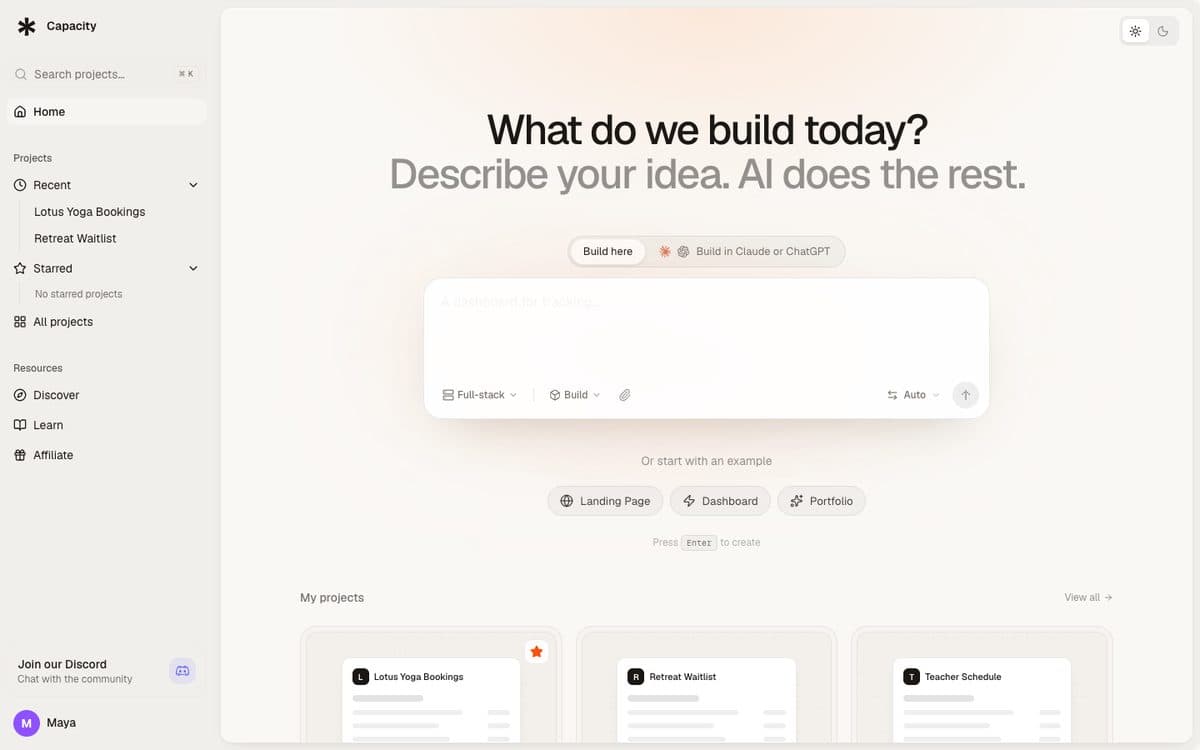
Capacity turns a plain-language description into a working app: a React front end, a server and its own SQLite database (through Drizzle), published at a capacity.studio address or on your own domain. You change it by chatting and see each change in a preview.
Why pick Capacity
- Every app gets its own database as part of the build; for login, you choose Clerk or Auth0 as an extension, or a Supabase connection.
- Build from Claude, ChatGPT or Mistral through Capacity's connector: your own subscription writes the code, unlimited on every paid plan.
- A full version history, the code as a zip on any paid plan, and Capacity Desktop (macOS and Windows) to push it to your own GitHub.
Watch out for
- Login isn't built in: people can't sign in until you add Clerk, Auth0 or a Supabase connection.
- The web app has no free plan: paid plans start at $25 a month. Capacity Desktop has a free plan with one project.
- A smaller community and template library than Lovable's or Bubble's.
Pricing
Starter $25/month (100 credits), Growth $69/month (250 credits), Professional $129/month (500 credits), Business $299/month (1,000 credits). Every plan includes unlimited projects, custom domains and unlimited building from Claude and ChatGPT.

02
Lovable
Best for a backend generated with the app: database, login, storage and row level security in Lovable Cloud.
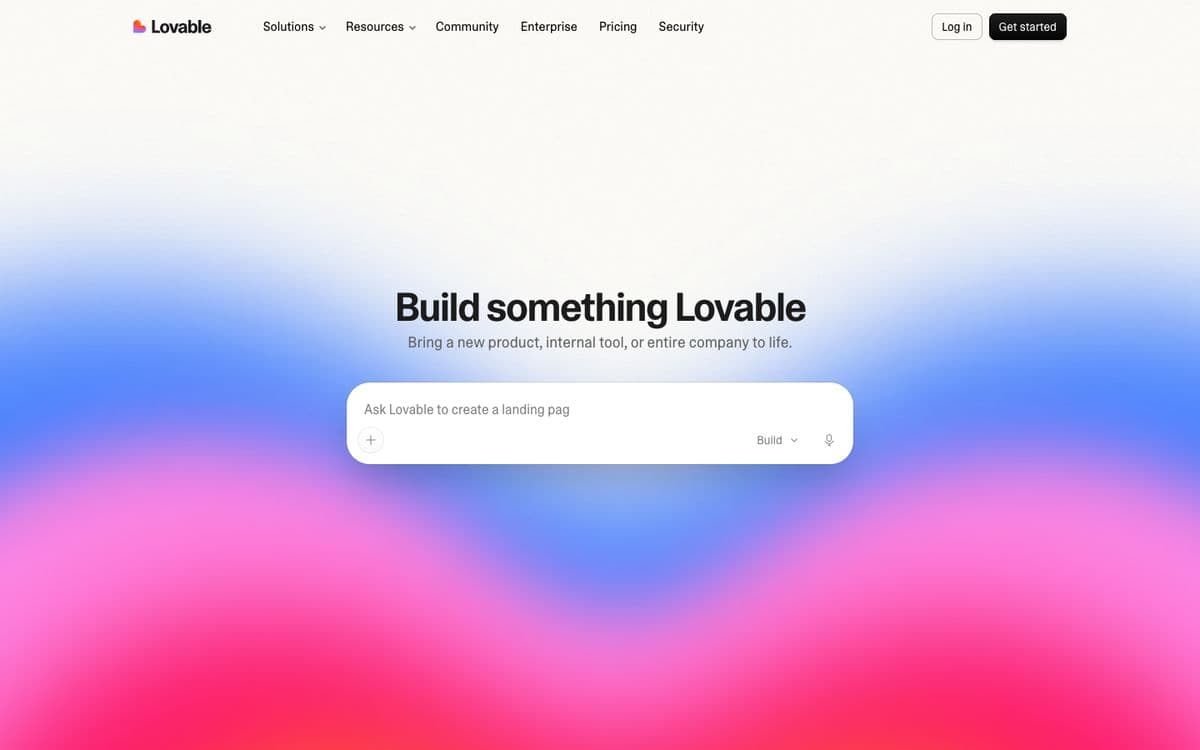
Lovable builds web apps from a chat with a live preview beside it. Lovable Cloud, its built-in backend on Supabase's open-source foundation, is on by default and adds a Postgres database, user login, file storage, realtime and server functions. Ask for login and Lovable generates the sign-up and login pages and protects each user's data with row level security.
Why pick it
- Sign-in by email and password, phone codes, Google, Apple, Microsoft or SAML SSO; Lovable manages Google, Apple and Microsoft, so you need no developer accounts.
- Row level security policies are set up as features are built, and daily backups are kept for about 14 days.
- A full database export, structure and data, including users' accounts and password hashes, so they keep their passwords if you move to Supabase.
Watch out for
- Each message uses credits, and Lovable Cloud usage is billed in credits too once its monthly grant is used.
- You pick the data region (Americas, Europe or Asia Pacific) when Cloud is turned on, and it can't be changed later.
Pricing
Free: 5 build credits a day, up to 30 a month. Pro: €25/month for 100 monthly credits, with rollovers, top-ups and custom domains. Business: €50/month, adding a team workspace and SSO. Prices shown in euros from France.

03
Base44
Best for login, roles and record-level rules generated with the app, at the lowest entry price here.
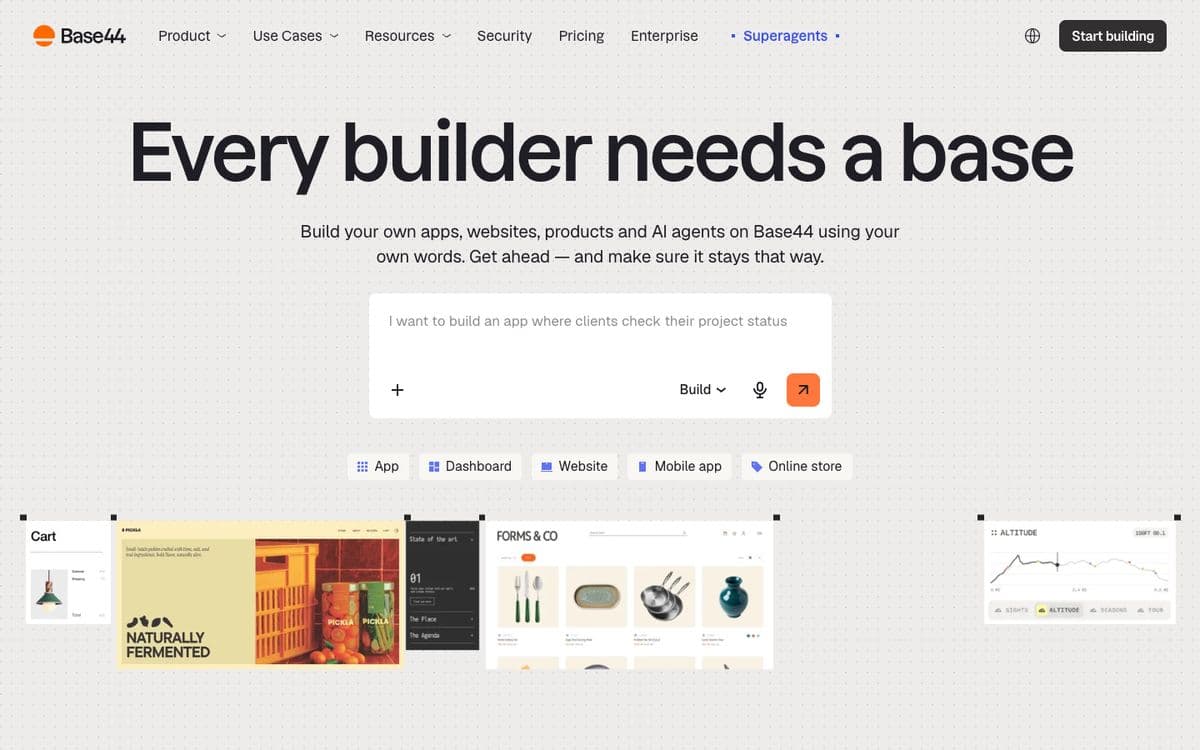
Base44, owned by Wix since 2025, builds the front end, backend, database, user login and payments from a plain-language description, runs the apps on its own infrastructure, and connects to tools like Gmail, Slack, Notion and HubSpot. It makes websites, internal tools, online stores and mobile apps.
Why pick it
- Login, sign-up and password reset pages come built in, with email and password plus Google, Microsoft, Facebook and Apple sign-in you switch on.
- Admin and User roles in every app, more roles on request, and data rules such as Creator Only, where people only see the records they created.
- The lowest entry price for an app builder on this list: Starter is $16 a month billed yearly.
Watch out for
- Private apps, open only to people you invite, need a paid plan, and SSO needs a Business or Enterprise plan.
- Google sign-in shows base44.com on the consent screen unless you use your own Google credentials, from the Builder plan.
Pricing
Free: 25 message credits a month. Billed yearly: Starter $16/month (100 message credits), Builder $40 (250), Pro $80 (500), Elite $160 (1,200). Monthly billing costs about 20% more.

04
Replit
Best for a PostgreSQL database and login set up by the Agent, with the code workspace beside it.
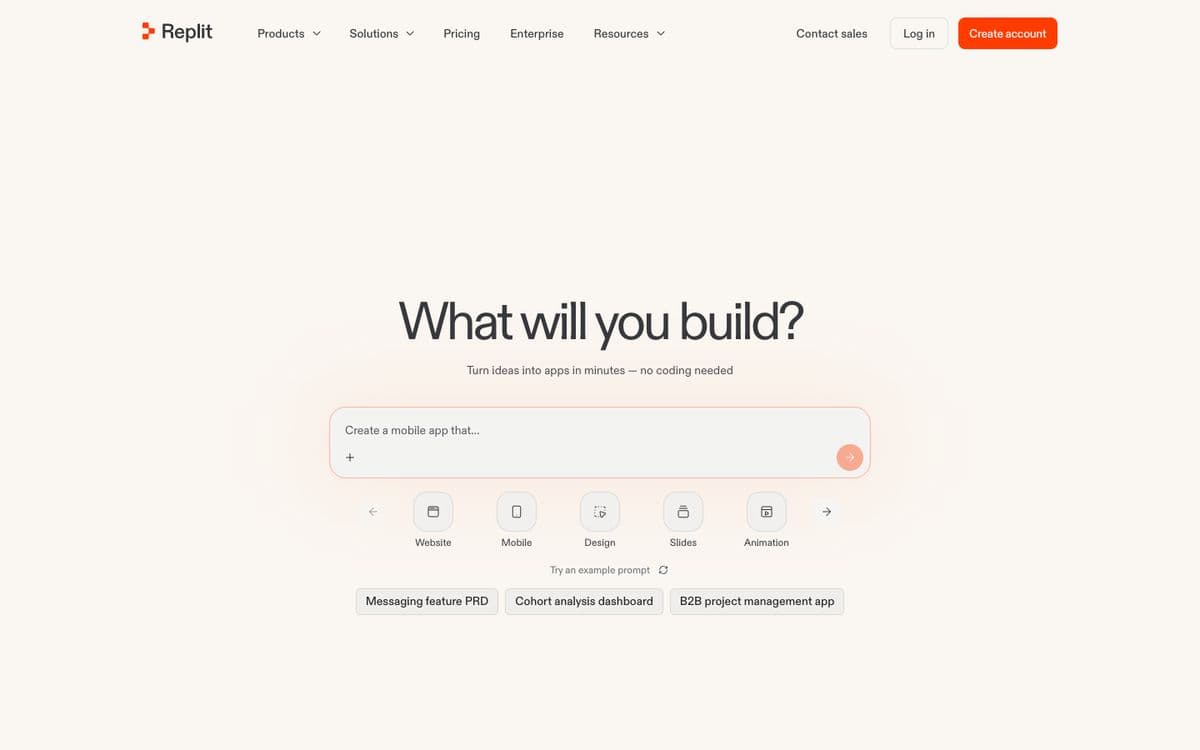
Replit Agent builds web and mobile apps from a chat inside a full cloud workspace. Ask for a database and it sets up a managed PostgreSQL database, with separate development and production databases. Ask for sign-in and it wires up Replit Auth, where people sign in with a Replit account, or Clerk Auth, a dedicated Clerk tenant with your own branding and login methods.
Why pick it
- Both login options are provisioned by the Agent, with no separate dashboard sign-up or OAuth keys to copy.
- 20 GB of database storage included per app (50 GB on Pro), and the database restores to any Agent checkpoint.
- Any PostgreSQL client or ORM can connect to the database.
Watch out for
- Replit Auth shows a Replit-branded sign-in page and needs a Replit account; Replit recommends Clerk Auth for customer-facing apps.
- The database bills compute time and storage, and heavier Agent work is billed by effort beyond your plan's credits.
Pricing
Core: $20/month ($18/month billed yearly), with up to 30 hours of chat on Free Mode and $20 of usage for the more powerful models. Pro: $100/month ($90/month billed yearly). Enterprise on request. No free plan is listed on the pricing page.

05
Bolt.new
Best for a built-in database with email and Google sign-in, on a free plan generous enough to try a real idea.
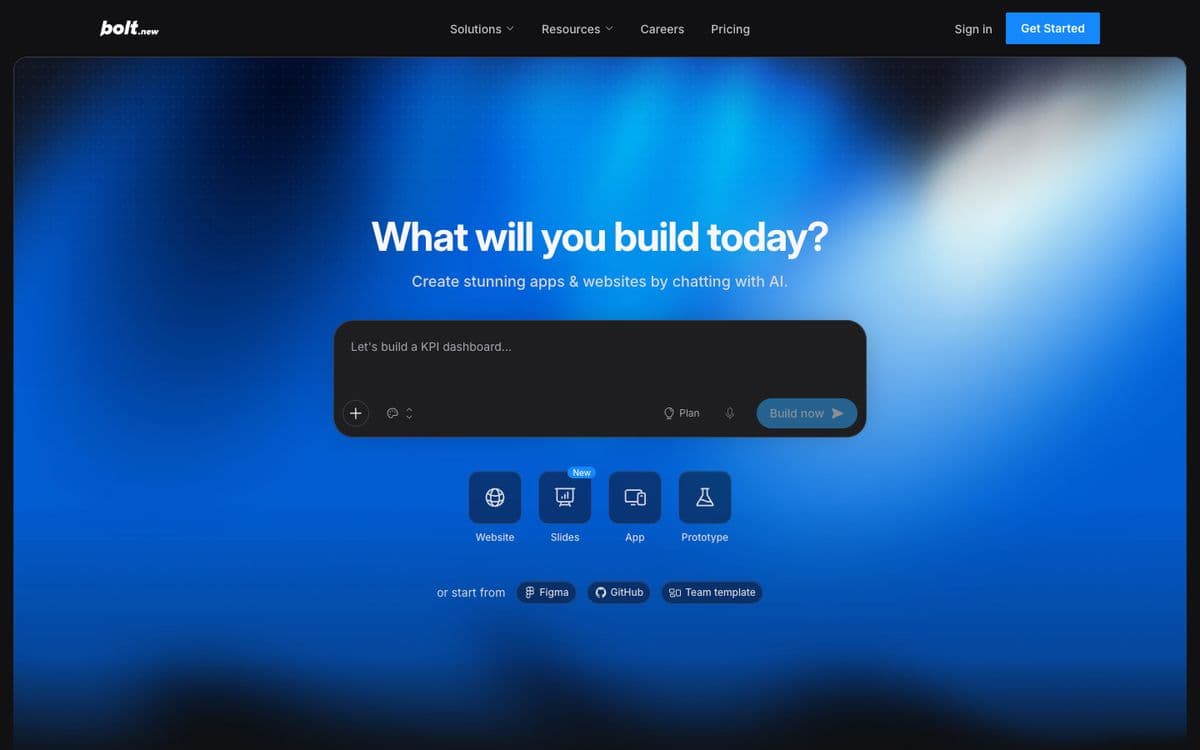
Bolt, from StackBlitz, builds websites and web apps from a chat in your browser. Bolt Cloud, its built-in backend, adds hosting, domains and Bolt Database: Bolt creates a database when the project needs one, with sign-in settings, file storage, server functions and a security audit that flags missing row level security policies.
Why pick it
- Unlimited databases, created automatically when a project needs one.
- Email sign-up with confirmation and leaked-password protection on every plan, plus Google sign-in.
- Export any table as CSV or JSON, and on Pro or Teams claim the whole database into your own Supabase account.
Watch out for
- Sign-up and login may not be added on their own: you ask Bolt for them, and Google sign-in needs OAuth credentials you create in Google Cloud.
- Billing is in tokens, and long fix-and-retry sessions on a large project use them up faster.
Pricing
Free: 300K tokens a day, 1M a month. Pro: $25/month, no daily limit, from 10M tokens a month, unused tokens roll over. Teams: $30 per member per month.

06
Floot
Best for a Postgres database and sign-in included, built from Claude, ChatGPT or Cursor.
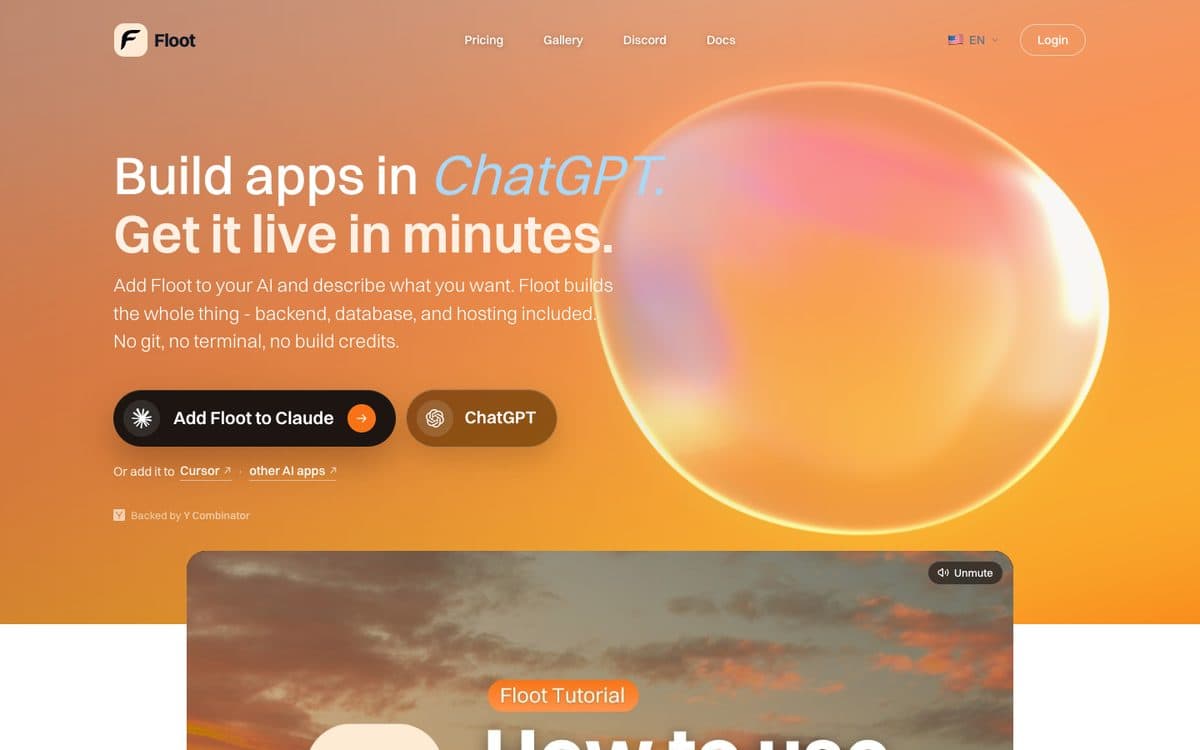
Floot builds apps from the AI you already use: add it to Claude, ChatGPT or Cursor as a connector and describe the app. Every project comes with a managed Postgres database, sign-in, file storage and email, hosted by Floot with a live link. Asking for login adds email and password sign-up, password reset and a login page, with an admin account for you.
Why pick it
- Google and Microsoft sign-in are brokered by Floot, so there's no OAuth app to register; Apple, GitHub, LinkedIn, Slack and others work with your own credentials.
- Download the whole database as a pg_dump file on any plan, including Free.
Watch out for
- The database runs on Neon, on AWS in US East, and sleeps after about a minute without queries, so the next request can take a little longer.
- Plans cap building actions per day (100 on Free, 1,000 on Pro) and include a monthly hosting allowance ($10 on Pro, $25 on Power).
Pricing
Free: 100 building actions a day, 2 mobile app builds a month. Pro: $25/month with 1,000 actions a day, $10 of hosting and 5,000 AI credits a month, custom domains. Power: $100/month with 5,000 actions a day, $25 of hosting and 15,000 AI credits. Yearly billing gives two months free.
Business apps with users built in

07
Zite
Best for team and client apps with sign-in, roles and unlimited users on every plan.
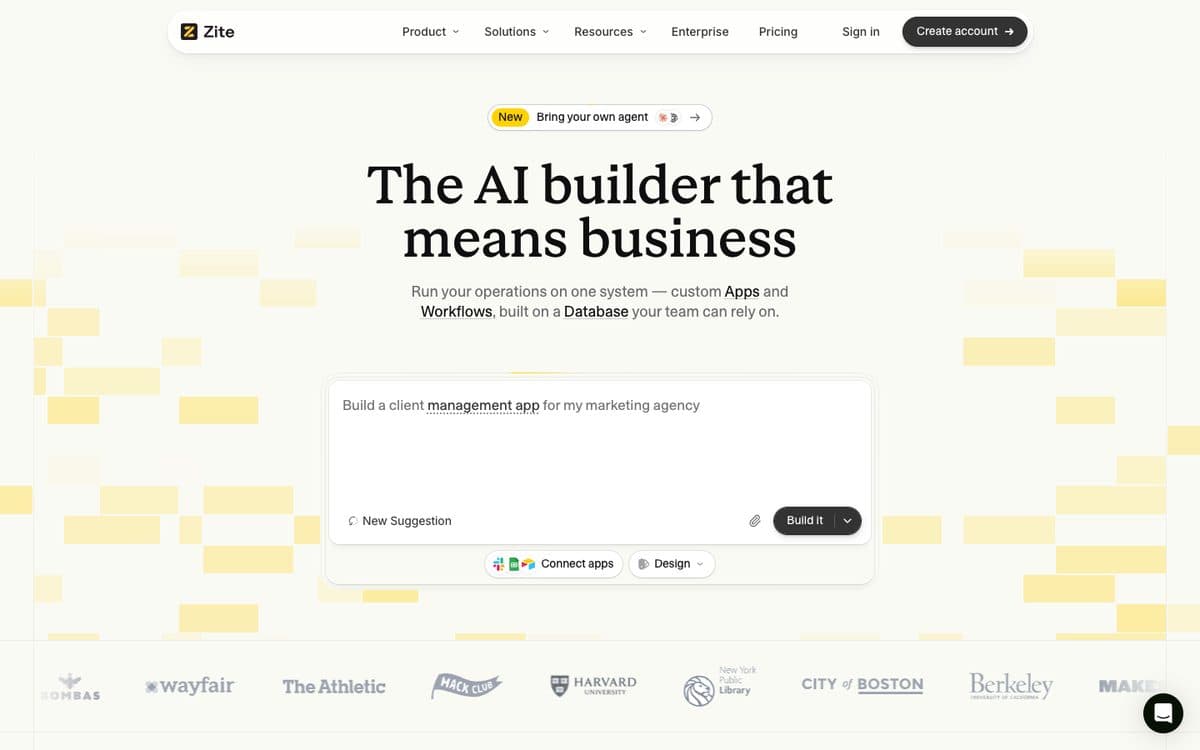
Zite builds business apps and workflows on its own database from a description, like "a client management app for my marketing agency". Internal apps use your organization's members and permissions. Apps shared to the web get their own login, by magic link or Google, with SSO on Enterprise. Roles set database permissions by table and action.
Why pick it
- Unlimited users on every plan, which suits tools a whole team uses.
- You decide who can sign up: invite only (the default), anyone, or only the email domains you allow.
- Each table exports to CSV, and imports take up to 250,000 records at once from CSV, Excel, Google Sheets or Airtable.
Watch out for
- Records and workflow runs are capped per plan: 5,000 records and 1,000 runs a month on Free.
- Monthly credits cap how much you build: 50 on Free (10 messages a day), 100 on Pro, 400 on Business.
Pricing
Free: 50 credits a month, 5,000 records, 1,000 workflow runs. Billed yearly: Pro $20/month (100 credits, 100,000 records, a custom domain), Business $75/month (400 credits, 250,000 records, your own AI). Team and Enterprise on request.

08
Tadabase
Best for a business app described in plain English, with logins, permissions and unlimited app users included.
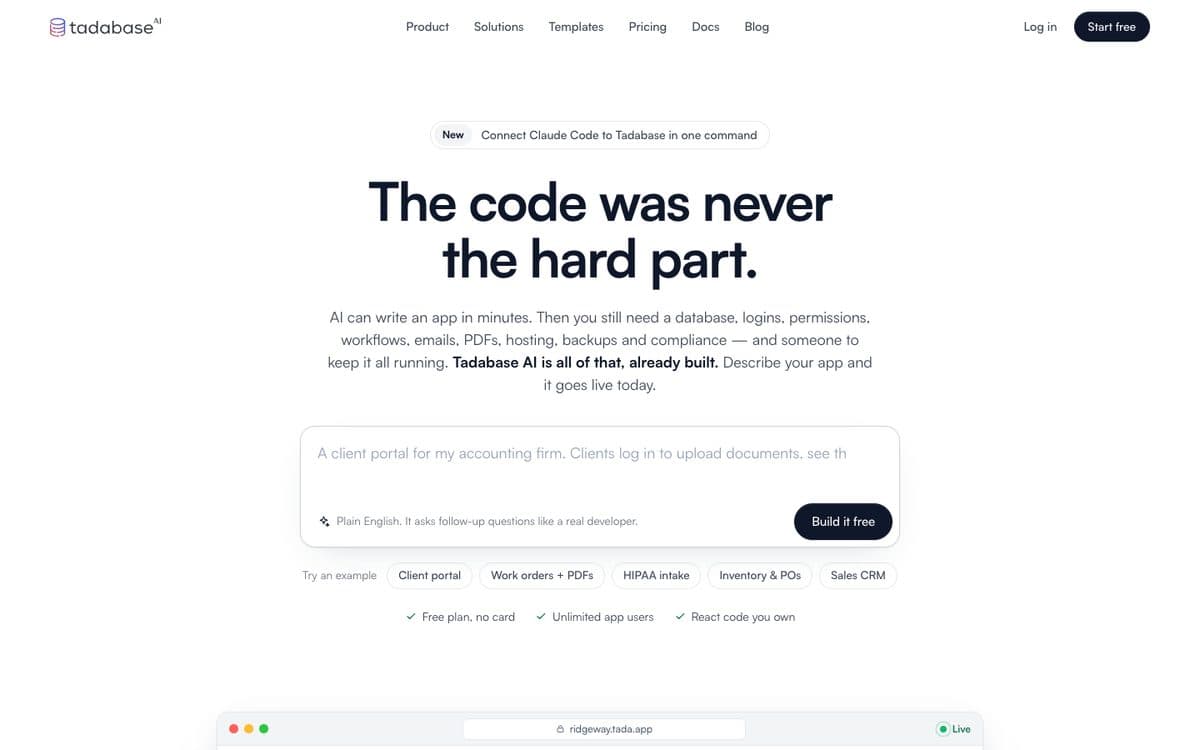
Tadabase AI is Tadabase's new builder: you describe the app your business needs, it asks follow-up questions, then builds the database, logins, permissions, workflows, emails, PDFs and hosting on Tadabase's platform. It generates React code you own, and Claude Code connects to it in one command. Existing customers keep their original Tadabase plans.
Why pick it
- Unlimited app users on every plan, which suits portals with many clients.
- What a portal needs is already built: database, logins, permissions, workflows, emails and PDFs.
- A free plan to start, with a one-time 300-credit welcome bonus.
Watch out for
- Starter publishes 3 apps ($9 a month for each extra one) with 25,000 records per app; external sources like Airtable or HubSpot start on Business, $250 a month.
- Always-on hosting starts on Pro.
Pricing
Free: 5 credits a day plus a 300-credit welcome bonus. Starter: $25/month, or $21 billed yearly (1,000 credits a month, 3 published apps, custom domain). Pro: $50 ($42 yearly). Team: $100 ($84). Business: $250 ($210). Unlimited app users on every plan.

09
Softr
Best for logins and per-group permissions on data you already keep in Airtable, Google Sheets or a SQL database.
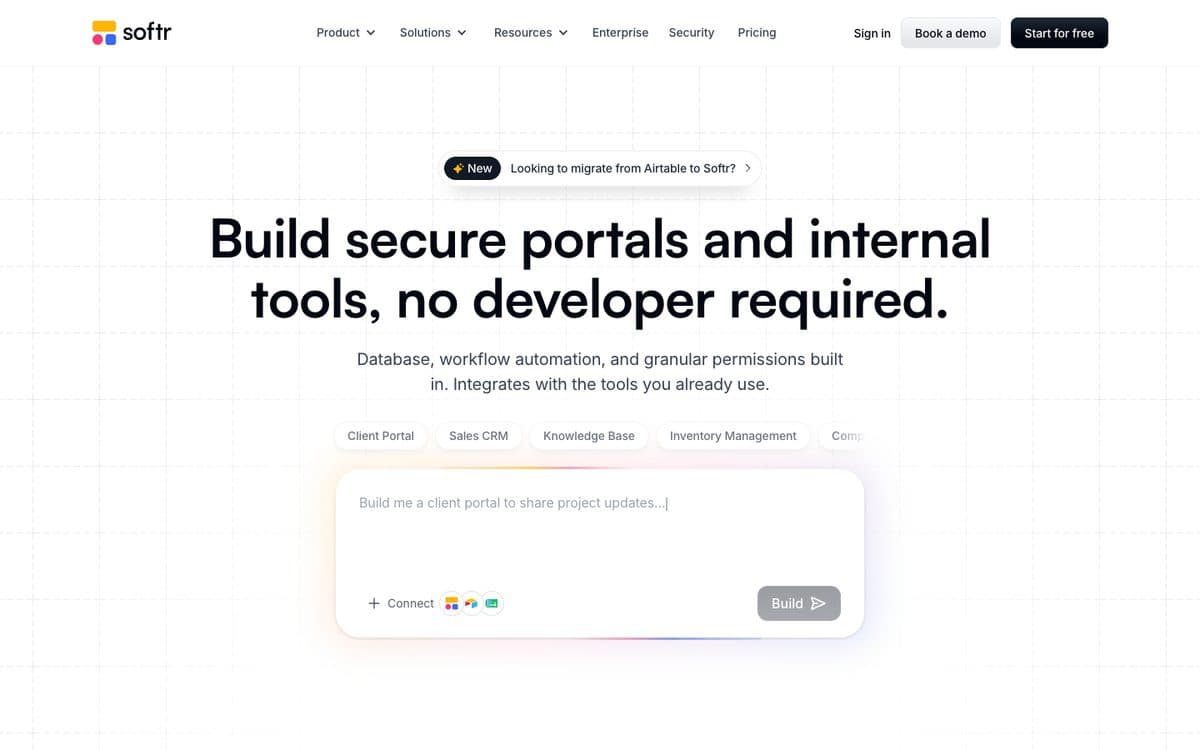
Softr is an AI app builder for business operations: secure internal tools and client portals with databases, workflow automation and integrations included. You build with AI or with no-code blocks, and connect data from its own databases or tools like Airtable and Notion.
Why pick it
- Email and password on every plan; one-time codes, Google sign-in and granular permissions from Pro.
- User groups decide which pages, blocks and records each person sees, with global data restrictions on Business.
- The data can stay where it is: Softr Databases, Airtable, Google Sheets, Notion or HubSpot, or PostgreSQL, MySQL and SQL Server on Business.
Watch out for
- App users are capped per plan: 5 on Free, 5 team plus 5 client users on Basic, 10 plus 50 on Pro, 30 plus 100 on Business.
- SSO (SAML or OpenID) is on Enterprise, or a paid add-on on Business.
Pricing
Free: 5 AI credits a month. Billed yearly: Basic $19/month (10 AI credits, custom domain), Pro $99/month (50 AI credits, no Softr branding, permissions, custom code), Business $329/month (100 AI credits, 2FA, installable mobile app with push notifications). Yearly billing gives two months free.

10
Glide
Best for internal apps for your own staff, private to your company by default.
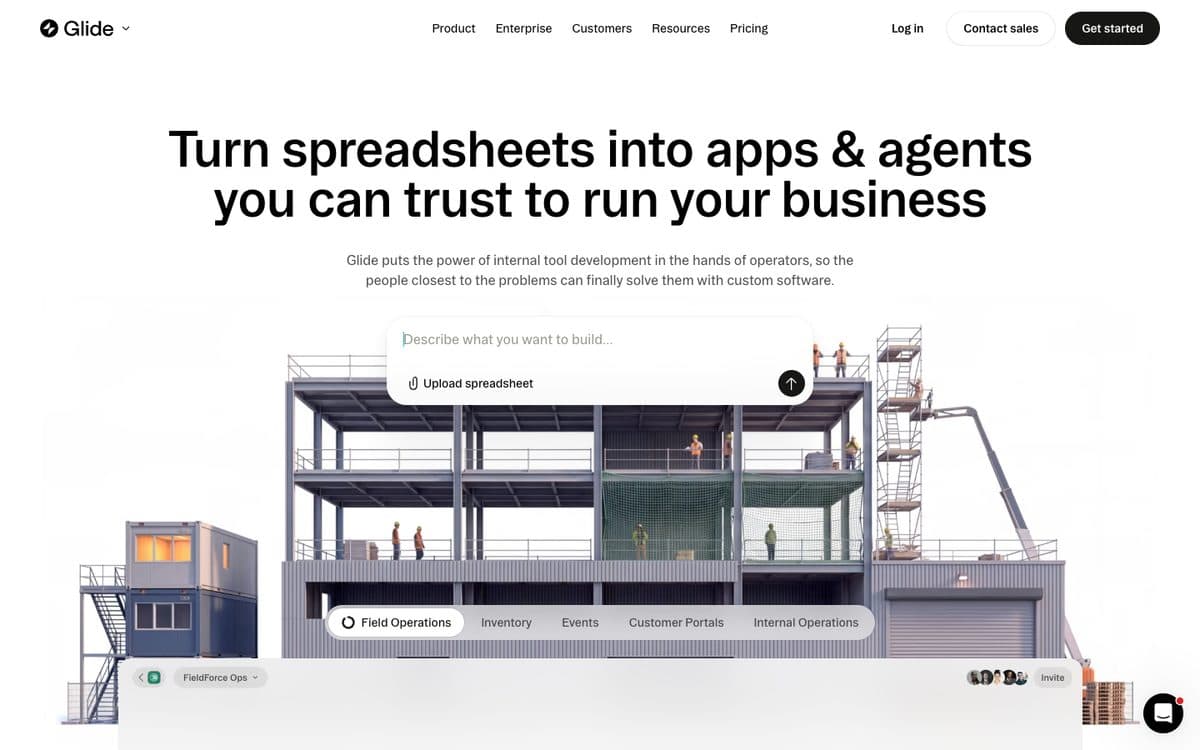
Glide is an AI app builder for internal business apps: you describe the tool, and Glide builds it on its own platform with integrations and workflows, then publishes it to your team or, from Plus, to the public. You choose how hard its agent works (light, medium or heavy).
Why pick it
- Apps are private to your company by default, and admins control access with roles from Pro and SSO on Enterprise.
- Each project has one database shared by all its apps, built from a spreadsheet, a file or a prompt, and every table exports to CSV.
- A free plan with 10 projects to try it.
Watch out for
- Publishing needs a paid plan, Basic apps are limited to your organization's members, and public apps with sign-in start on Plus at $50 a month.
- Published apps are capped below Pro: 2 on Basic, 5 on Plus.
Pricing
Free: limited credits, 2 team members, 10 projects. Basic: $25/month (100 credits, 2 published apps). Plus: $50/month (250 credits, 5 published apps, public apps). Pro: $125/month for 5 members (500 credits, unlimited published apps and workflows). Enterprise on request.
Visual builder

11
Bubble
Best for apps with complex users, roles and privacy rules, built visually, on web and mobile.
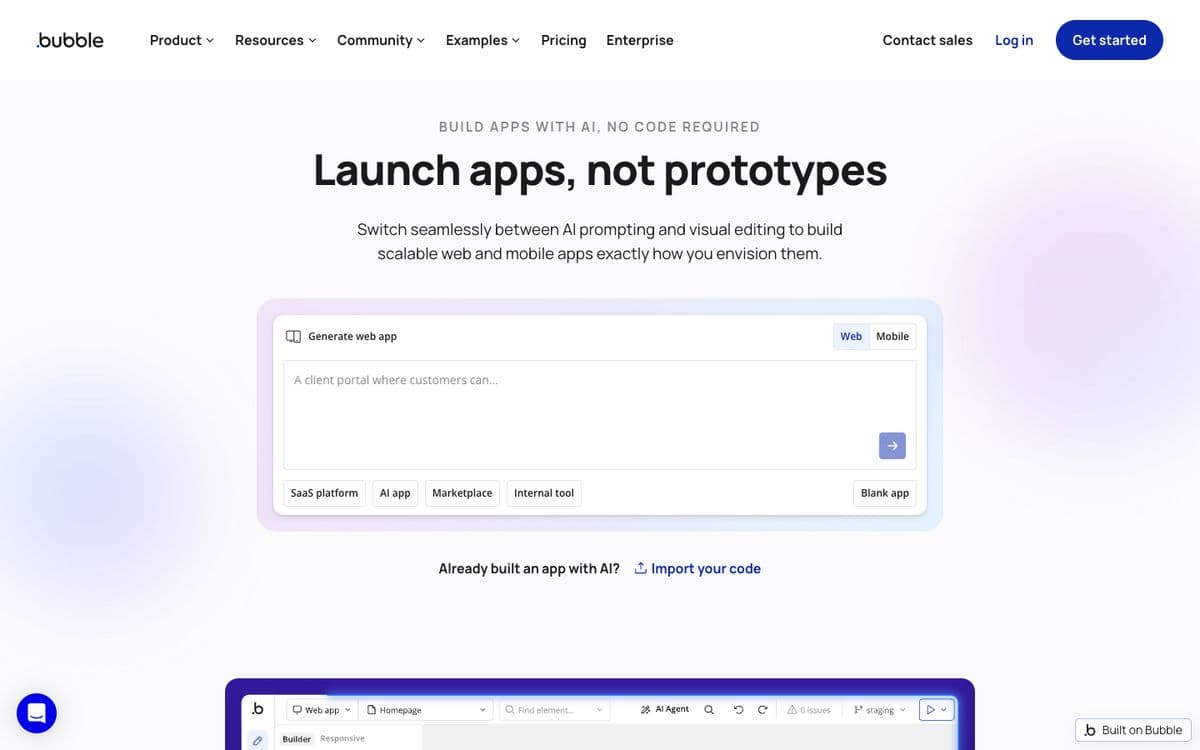
Bubble is the long-standing visual app builder. It now starts from an AI prompt and lets you switch between prompting and editing visually, for web, iOS and Android apps, with its own database and workflows.
Why pick it
- User accounts are built in: sign-up, login and sessions are handled, and passwords are hashed and salted.
- Privacy rules run on the server and can compare each record with the current user, for fine control over who sees what.
- Social logins through Bubble's plugins, or other providers through its API Connector.
Watch out for
- Bubble's privacy editor marks each data type "Privacy rules applied" or "Publicly visible": review every one before real data goes in.
- Importing and exporting CSV files needs a paid plan, and exports skip privacy rules because the app owner runs them.
Pricing
Free plan to build. Billed yearly: Starter $29/month, Growth $119/month, Team $349/month, each with more AI credits and workload units.
The 11 builders, side by side. From each official site, October 17, 2026.
| Feature | Capacity | Lovable | Base44 | Replit | Bolt.new | Floot | Zite | Tadabase | Softr | Glide | Bubble |
|---|---|---|---|---|---|---|---|---|---|---|---|
| Paid plans from | $25/month | €25/month | $16/month (yearly) | $20/month ($18 yearly) | $25/month | $25/month | $20/month (yearly) | $25/month | $19/month (yearly) | $25/month | $29/month (yearly) |
| Free plan | Desktop only (1 project) | Yes | Yes | None listed | Yes | Yes | Yes | Yes | Yes | Yes | Yes |
| Database | Its own SQLite database | Postgres (Lovable Cloud) | Built-in database | Managed PostgreSQL | Bolt Database | Managed Postgres (AWS US East) | Zite Database | Its own database | Softr Databases, or Airtable, Sheets, SQL | Project database from sheets or files | Its own database |
| Login | Extension: Clerk, Auth0 or Supabase | Email, phone, Google, Apple, Microsoft, SAML | Email, Google, Microsoft, Facebook, Apple | Replit Auth or Clerk, set up by Agent | Email and Google, on request | Email, Google, Microsoft; others with your keys | Magic link, Google; SSO on Enterprise | Logins built in | Password; email code and Google from Pro | Sign-in for public apps from Plus | Built in; social logins by plugin |
| Roles and permissions | – | Row level security policies | Admin and User roles, record rules | – | Row level security policies | Admin role for your account | Roles by table and action | Permissions built in | User groups; granular from Pro | Org-level roles from Pro | Privacy rules |
| Taking your data or code out | Code as a zip (paid plans) | Full database export | CSV per table | Connect any PostgreSQL client | CSV or JSON; claim into Supabase | pg_dump on any plan | CSV per table | React code you own | – | CSV per table | CSV, JSON, NDJSON (paid) |
How to choose. Start from what you need, not from the ranking.
 Database, login and row level security generatedLovable
 Roles and record rules at the lowest priceBase44A database built in, login from Clerk or Auth0Capacity
 A database, built from Claude, ChatGPT or CursorFloot or Capacity
 PostgreSQL and a code workspace in one placeReplit
 A free plan with a database and sign-inBolt.new
 Unlimited users for a team or client appZite
 Logins and permissions, unlimited app usersTadabase
 Logins on Airtable, Sheets or SQL dataSoftr
 Internal apps private to your companyGlide
 Complex privacy rules, built visuallyBubble
Questions people ask. Short answers, with the details above.
Which AI app builders include a database and user login?
Lovable (Lovable Cloud), Base44, Bolt.new, Floot, Zite, Tadabase, Softr and Bubble include both, and Replit's Agent sets up PostgreSQL with Replit Auth or a Clerk tenant. Capacity includes the database, with login added through Clerk, Auth0 or Supabase. Glide offers sign-in for public apps from its $50 Plus plan.
What's the cheapest AI app builder with a database and login?
Billed yearly, Base44 Starter is $16 a month, Replit Core $18 and Zite Pro $20 with unlimited users. Bolt.new, Floot, Tadabase and Capacity start at $25 a month, Lovable at €25. Lovable, Bolt.new, Floot and Zite also have free plans that include the database.
What is row level security, and do I need it?
It's a database rule that decides which rows a signed-in person can read or change, such as "customers only see their own orders". Any app storing private data needs it. Lovable sets these policies up as it builds, Bolt's security audit flags missing ones, Base44 offers rules like Creator Only, and Bubble uses server-side privacy rules.
Do I need my own Supabase account?
No. Lovable Cloud runs on Supabase's foundation without a separate Supabase setup, and Base44, Bolt, Floot, Replit, Zite and Bubble run their own databases. Bolt Database can be claimed into your own Supabase account on Pro or Teams, and Capacity offers a Supabase connection if you want your data and login there.
Can I choose where my app's data is stored?
On Lovable Cloud, yes: Americas, Europe or Asia Pacific, fixed once Cloud is on, with country-specific regions on request for Enterprise. Floot's databases run on AWS in US East. The other builders' documentation we read offers no region choice.
Can I export my users and data if I leave?
Lovable exports the whole database, password hashes included, so users keep their passwords in a Supabase project. Floot downloads a pg_dump on any plan. Bolt exports tables as CSV or JSON, Base44, Zite and Glide as CSV, and Bubble as CSV, JSON or NDJSON on a paid plan.
Which ones offer SSO for company logins?
Lovable supports SAML SSO through providers like Okta or Microsoft Entra ID. Base44 offers SSO on its Business and Enterprise plans, Zite and Glide on Enterprise, and Softr on Enterprise or as a paid add-on on Business.
Is login with Clerk or Auth0 worse than built-in login?
Not necessarily. Built-in login is quicker to start and lives with your data. Clerk and Auth0 are dedicated login services that run alongside the app: Replit provisions a Clerk tenant from its Agent, and Capacity adds Clerk or Auth0 as an extension. The cost is one more service to set up.
Related comparisons
Try the one we build.
Describe your app in a sentence and Capacity builds it, or connect it to Claude or ChatGPT and build from the chat. Plans from $25 a month.