
Quick answer
Google recommends Google AI Studio if you built with the App Prototyping agent and want to stay in the browser, and Google Antigravity if you work in the code. Both have a migration path from Firebase Studio's Move now button.
If you'd rather leave Google's tools, export your code as a zip or to GitHub first. Capacity, which we make, imports a GitHub repository and runs it with a live preview; Replit and Bolt.new import from GitHub, Lovable imports a zip, and Cursor or Claude Code work on the folder itself. Your Firestore database and Firebase Authentication keep working wherever the code goes.
| Tool | Best for | Paid plans from | Free plan | Watch out for |
|---|---|---|---|---|
 Google AI Studio | apps you built with the App Prototyping agent: Google's recommended path in the browser. | Free; paid API by usage | Yes, the Gemini API free tier | Deployed apps use your API key and Cloud Run |
 Google Antigravity | code-first projects, templates and imported repositories: Google's recommended path on your computer. | Free; more with Google AI Pro | Yes, with weekly rate limits | Limits depend on your Google AI plan |
| Capacity | moving a Firebase Studio app off Google's tools without touching code: the agent imports your repository and runs it. | $25/month | Web app: no. Desktop: 1 project | No free plan on the web; login via Clerk, Auth0 or Supabase |
 Replit | an AI agent and a full code workspace in the browser, importing your repository from GitHub. | $20/month | None listed | Agent usage is billed on top |
 Bolt.new | a browser builder that starts from a prompt, a Figma file or your GitHub repository. | $25/month | Yes, 1M tokens a month | Token use grows with the project |
 Lovable | a chat-to-web-app builder: import your code as a zip, then sync it to a new GitHub repository. | €25/month | Yes, 5 credits a day (up to 30 a month) | Builds web apps, not native ones |
 Cursor | an AI editor on the exported folder or your GitHub repository. | $8/month | Yes, limited | You need to be comfortable with code |
| Claude Code | an agent in your terminal on the exported project, with the Claude plan you may already have. | Claude Pro (€18/month) | No | No hosting; built for developers |
Why you need to move. What Google is changing, and what stays.
Google announced the sunset on March 19, 2026, as it folded Firebase Studio into AI Studio and Antigravity. “The product churn (Project IDX -> Firebase Studio -> Shutdown) is unfortunate, but I'm glad to see efforts being concentrated,” xnx wrote on Hacker News in March 2026.
It shuts down on March 22, 2027
On that date Firebase Studio closes and all remaining data is permanently deleted. Since June 22, 2026 it accepts no new workspaces and no new users; you can still work in existing ones and migrate them.
Google's path has changed before
Firebase Studio grew out of Project IDX. Google now points app builders to AI Studio and developers to Antigravity, so some people use the move to pick a tool on their own terms. “Working through this as a consumer and enterprise customer has been a confusing experience, to say the least,” bdashdash wrote on Hacker News in October 2026, listing Duet, Firebase Studio and Studio Bot among Google's coding tools.
Your Firebase backend stays
Only the development environment goes away. Cloud Firestore, Firebase Authentication and App Hosting keep working, so the code can move anywhere and keep using the same Firebase project.
Some things don't come along
The agent's chat history isn't in the exported zip; it sits in the workspace's /home/user/.idx/ai folder. Only the person who created a workspace can use Move now, and a shared workspace's export still points to its owner's Firebase project.
How we compared them. The same questions for every tool.
- Whether it can pick up the code you already have: from Firebase Studio, a GitHub repository or a zip.
- Whether it keeps working with your existing Firebase project, Firestore and Authentication.
- Where you build: in the browser, in a desktop app, or in your own editor and terminal.
- Hosting and your URL: whether you can keep publishing to Firebase App Hosting or move to a new address.
- How you pay: free tiers, a Google AI plan, credits, tokens or usage.
- Who it's built for: people who built with prompts, or developers who work in the code.
Google's own paths

01
Google AI Studio
Best for apps you built with the App Prototyping agent: Google's recommended path in the browser.
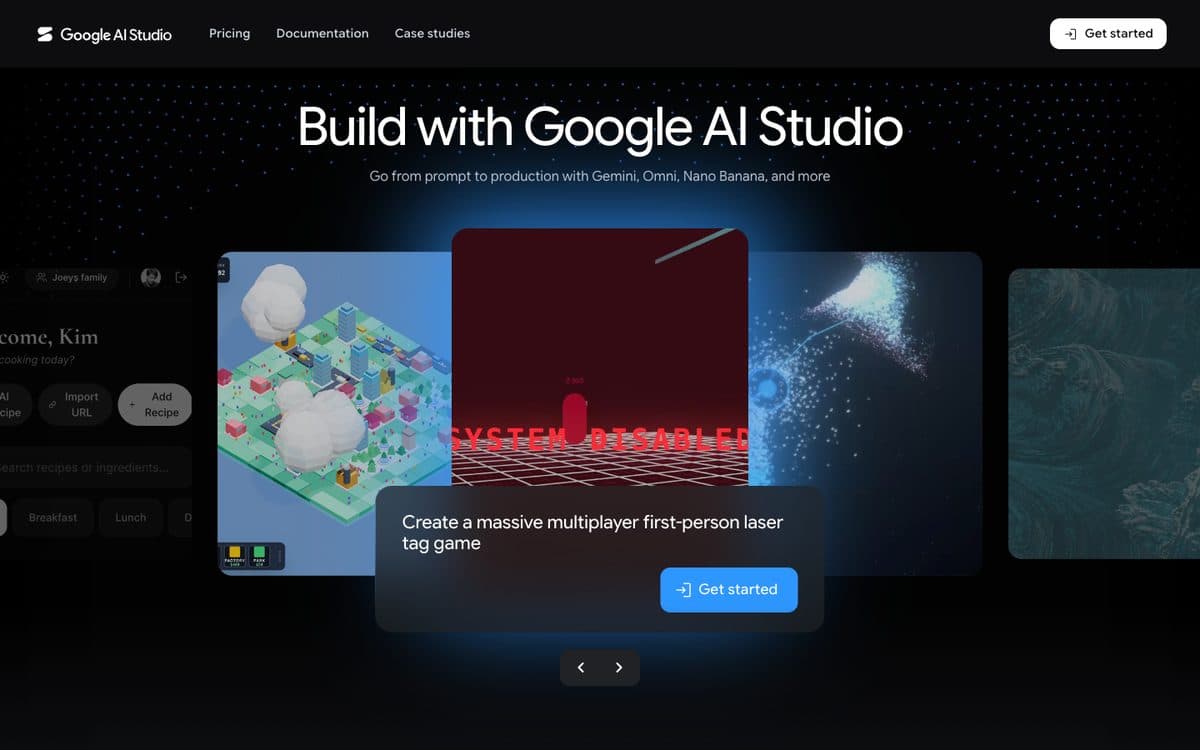
Google AI Studio's Build mode turns a prompt into a full-stack web app, with a React front end and a Node.js server, or a native Android app in Kotlin. Its agent comes from Antigravity, it can set up Firestore and Firebase Authentication for you, and it publishes to Google Cloud Run. From Firebase Studio, Move now → Prepare for AI Studio → Move to Google AI Studio opens your code in a new AI Studio workspace.
Why pick it over Firebase Studio
- A migration button inside Firebase Studio, and two ways to publish: keep your hosted.app URL through App Hosting and GitHub sync, or publish to Cloud Run in one click.
- Free to start on the Gemini API's free tier, and eligible accounts publish up to two apps on the Starter Tier without a Google Cloud billing account.
- Two-way GitHub sync and a zip export, so the code stays yours.
Watch out for
- To keep your existing URL you set your Gemini API key in the Firebase console yourself, because .env files shouldn't go to GitHub.
- Google Sign-In needs your new AI Studio domain added to Firebase Authentication's authorized domains.
- A published app uses your API key for every user's Gemini calls, and Cloud Run pricing may apply.
Pricing
Free tier: free input and output tokens, limited access to some models, content used to improve Google's products. Paid tier: pay as you go per million tokens, priced by model. Deployed apps run on Google Cloud Run, billed by usage; the Starter Tier publishes up to two apps without a billing account.

02
Google Antigravity
Best for code-first projects, templates and imported repositories: Google's recommended path on your computer.
Antigravity is Google's agent platform: a desktop app, an agentic IDE, IDE extensions, a command-line tool and an SDK, with agents working in parallel. To migrate, you download your Firebase Studio workspace as a zip, open it in the Antigravity IDE and run the @fbs-to-agy-export prompt; the agent converts the project, then publishes it to Firebase App Hosting when you ask it to.
Why pick it over Firebase Studio
- A guided migration agent, and publishing to your existing App Hosting URL.
- Free for individuals, with a weekly agent quota and models including Gemini 4 Hydrogen, Claude Sonnet 4.6 and Claude Opus 4.6.
- The project runs locally, with no cloud limits on scripts or tools.
Watch out for
- You need Node.js 20 or later and the Firebase CLI installed, and it's a developer environment.
- Higher quotas and the newest models (Gemini 4 Neon, Claude Opus 5.5) come with Google AI Pro or Ultra.
“the usage limits don't seem quite as good as either claude or codex, but I'm on the $20 plans,” bwat49 wrote on Hacker News in November 2026.
Pricing
Individual: $0/month with an agent quota refreshed weekly. Google AI Pro (€21.99/month in France) and Google AI Ultra (from €99.99/month) refresh quotas every 5 hours and add Google's newest models and Claude Sonnet and Opus 5.5. Organisations: through Google Cloud, with Gemini Enterprise Standard and Plus plans from $30 per seat per month, or pay as you go.
Build from a description
03 · our product
Capacity
Best for moving a Firebase Studio app off Google's tools without touching code: the agent imports your repository and runs it.
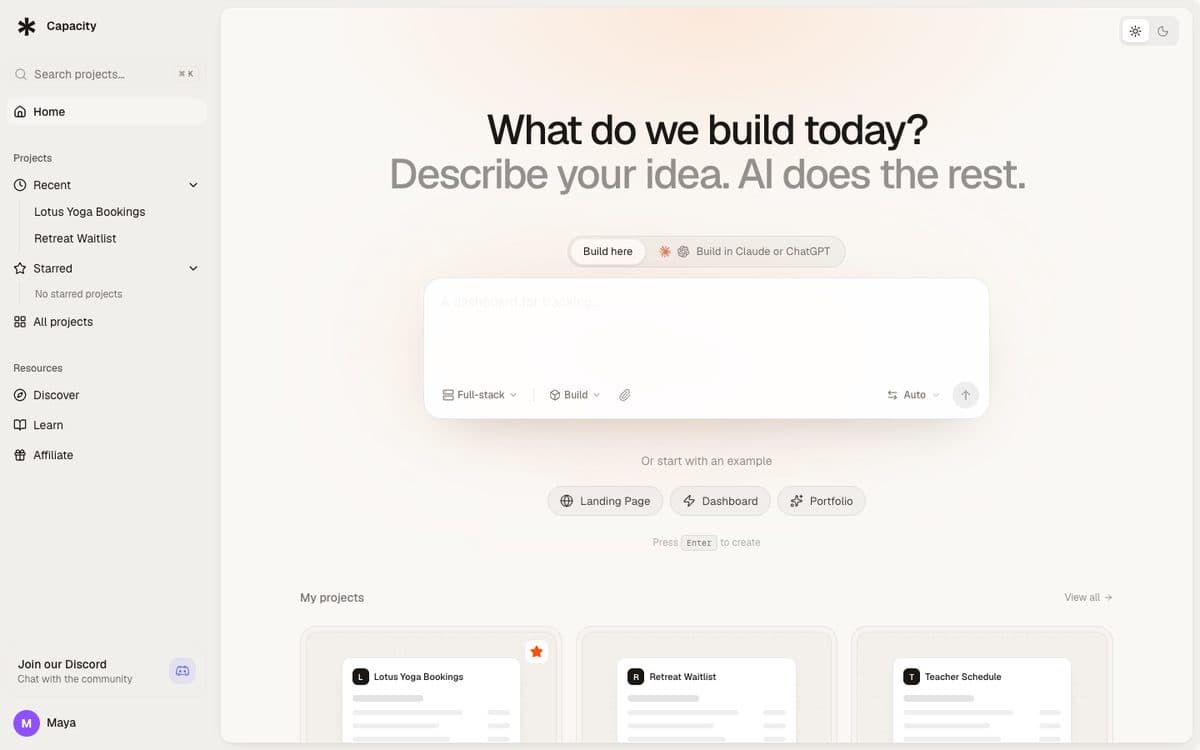
Capacity turns a plain-language description into a working app: a React front end, a server and its own database, published at a capacity.studio address or on your own domain. You change it by chatting, each change shows up in the preview, and any earlier version is one click away. In the project editor you choose the model (Claude Opus 5.5, Claude Sonnet 5.5, Fable 5.1, Mistral Large 4 or Kimi K3) or leave it on Auto; Capacity's agent runs on Claude Sonnet 5.5, Opus 5.5 or Fable 5.2. “I built a new project from scratch thanks to capacity and I've been kind of blown away,” François V. wrote on Trustpilot in January 2026, adding that issues along the way got quick answers.
Why pick Capacity over Firebase Studio
- Export your Firebase Studio workspace to GitHub, connect GitHub in Capacity (Connect a tool), and ask the agent to import the repository: it reads the code, works out how to start it and shows a live preview.
- An imported project stays on your own repository: the agent pushes to a capacity branch and opens pull requests. That needs admin rights on the repository; without them it works on a copy.
- Build from the AI you already pay for: connect Capacity to Claude, ChatGPT or Mistral and build from the chat. Your subscription writes the code, Capacity hosts the app, and building this way is unlimited on every paid plan.
- Plug your own Claude plan into the Capacity agent (Connect a tool → Claude): its work then costs no credits.
Watch out for
- Your Firebase project's keys and your Gemini API key go in as the project's variables.
- We haven't tested every Firebase Studio export this way, so check the preview before you rely on it.
- The web app has no free plan for building: paid plans start at $25 a month.
Pricing
Starter $25/month (100 credits), Growth $69/month (250 credits), Professional $129/month (500 credits), Business $299/month (1,000 credits). Every plan includes unlimited projects, custom domains and unlimited building from Claude and ChatGPT.

04
Replit
Best for an AI agent and a full code workspace in the browser, importing your repository from GitHub.
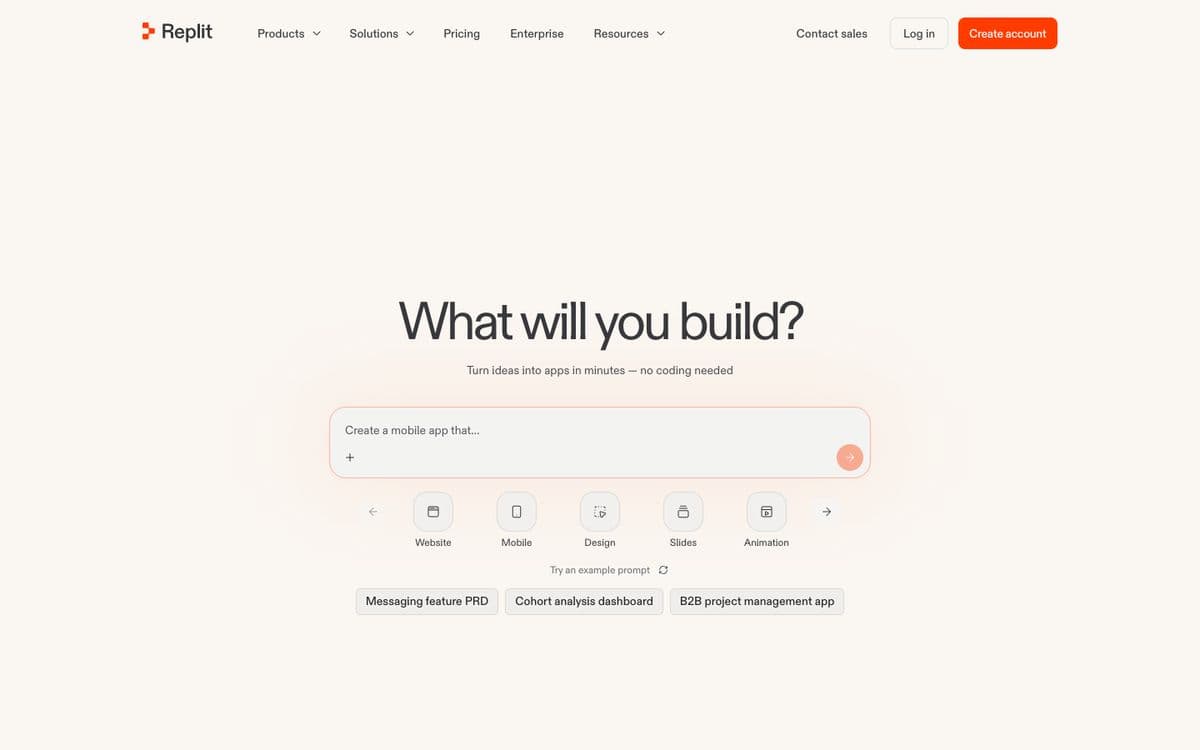
Replit pairs its Agent, which builds apps from a description, with a full cloud workspace: editor, database, hosting and deployment. You can stay in the chat, or open the code whenever you want to change something yourself. It builds websites and mobile apps. “You can get to 80% of a project very quickly, it’s the final 20% that gets tricky,” James W. wrote on Trustpilot in December 2025, in a four-star review.
Why pick it over Firebase Studio
- Everything from the first prompt to hosting lives in one product.
- You can move into the code as you learn, without leaving the tool.
- A Plan mode and up to ten agents working in parallel on the Pro plan.
Watch out for
- Heavier work is billed by effort beyond the credits in your plan, so a long build is hard to price in advance.
- The workspace shows more of the technical side than Lovable does, which can be a lot for non-technical founders.
“Complex tasks that previously cost $5–$10 started costing $20–$70+ with zero real-time visibility into the charge,” Mark P., on the Pro plan, wrote on Trustpilot in July 2026.
Pricing
Core: $20/month ($18/month billed yearly), with up to 30 hours of chat on Free Mode and $20 of usage for the more powerful models. Pro: $100/month ($90/month billed yearly). Enterprise on request. No free plan is listed on the pricing page.

05
Bolt.new
Best for a browser builder that starts from a prompt, a Figma file or your GitHub repository.
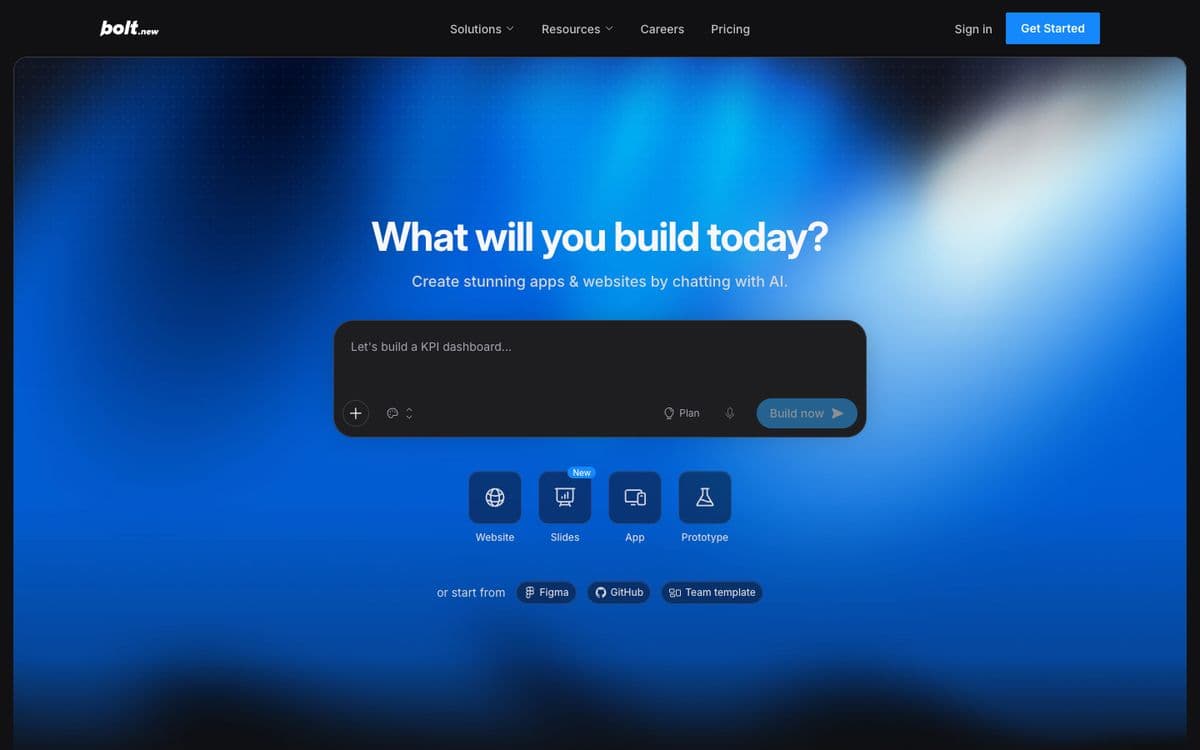
Bolt, from StackBlitz, builds websites and web apps from a chat in your browser and deploys them. It's the tool most comparison guides name first as a Lovable alternative, because the experience is the closest: describe it, watch it build, publish.
Why pick it over Firebase Studio
- The workflow is almost the same as Lovable's, so there's little to relearn.
- You can start from a prompt, a Figma file, a GitHub repository or a team template.
- On Pro, unused tokens roll over to the next month.
Watch out for
- Billing is in tokens, and long fix-and-retry sessions on a large project use them up faster.
- The free plan stops at 300K tokens a day and 1M a month.
“Had it build an app and it just kept draining the tokens as it tried to fix what should have been coded right in the first place,” Steve P. wrote on Trustpilot in July 2026.
Pricing
Free: 300K tokens a day, 1M a month. Pro: $25/month, no daily limit, from 10M tokens a month, unused tokens roll over. Teams: $30 per member per month.

06
Lovable
Best for a chat-to-web-app builder: import your code as a zip, then sync it to a new GitHub repository.
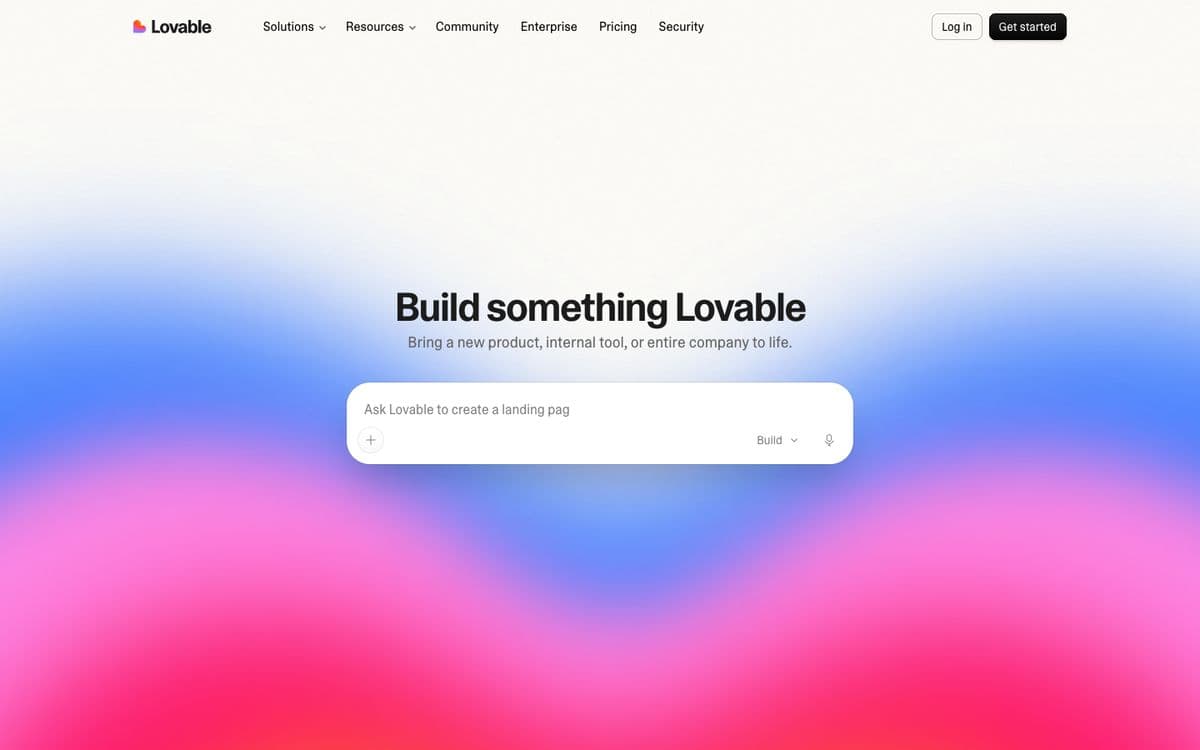
Lovable builds web apps from a chat with a live preview beside it. Lovable Cloud adds the backend, with a database, user login, file storage and server functions on a Supabase foundation, and your code syncs both ways with GitHub on every plan.
Why pick it over Firebase Studio
- The chat and the preview are the whole interface, so it feels lighter than a Replit workspace.
- Two-way GitHub sync on every plan, including Free, so a developer can take over later.
- It also works from its own desktop app, from ChatGPT and as an MCP server.
Watch out for
- Each message uses credits, and Lovable Cloud usage is billed in credits too once its monthly grant is used.
- For the App Store or Google Play, Lovable points you to a PWA or a Capacitor wrapper you set up yourself.
“Easy to use and fun! however slightly difficult to know how many credits are needed from the start and what the cost will be in the end,” Vincent C. wrote on Trustpilot in November 2026, in a four-star review.
Pricing
Free: 5 build credits a day, up to 30 a month. Pro: €25/month for 100 monthly credits, with rollovers, top-ups and custom domains. Business: €50/month, adding a team workspace and SSO. Prices shown in euros from France.
For developers

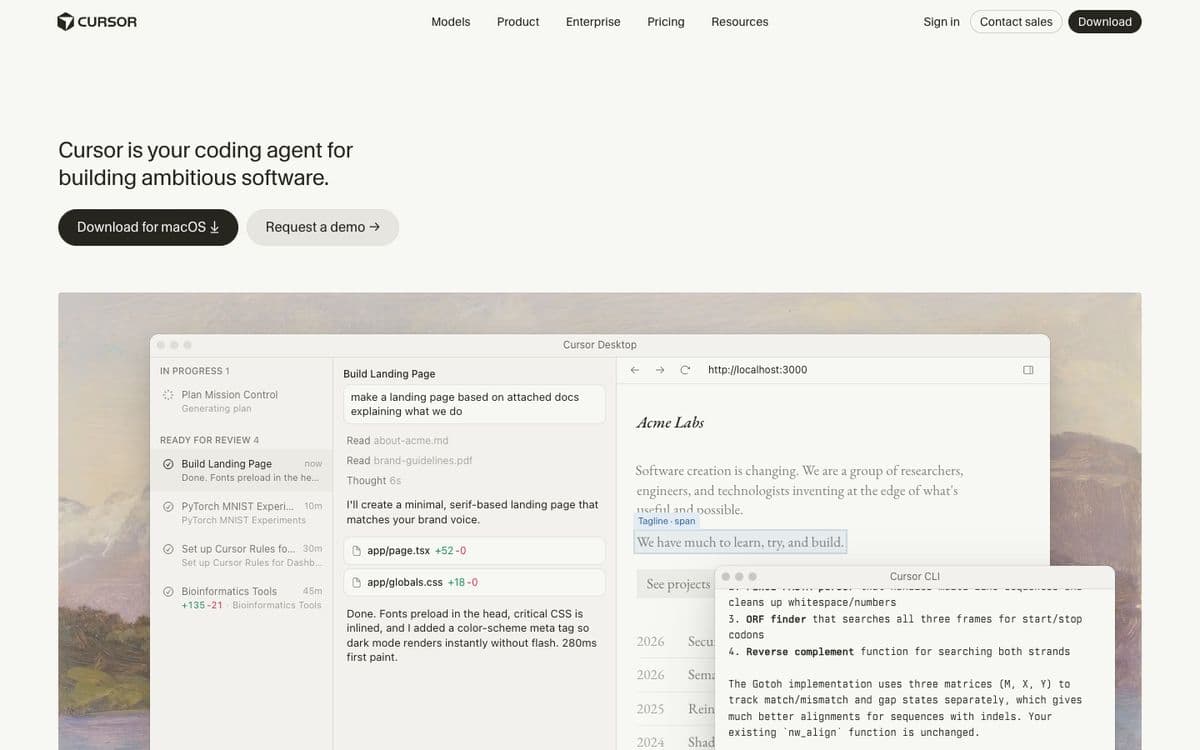
Cursor is a code editor built around AI agents. You open your project, describe the change, and the agent edits the files; you review and keep what works. Its plans now bundle Grok models and features from X.
Why pick it over Firebase Studio
- Your code stays on your machine and in your repository.
- Works on any stack, not only the ones a hosted builder supports.
- Cloud agents and automations on the higher plans.
Watch out for
- It's a developer tool: there's no hosting, and you deploy the app yourself.
- The plans mix AI usage with Grok and X features, so read what each tier includes.
“The VS Code interface is excellent, but the pricing is increasingly difficult to justify,” Jai wrote on Trustpilot in October 2026, locked into an annual plan.
Pricing
Free with limited AI usage. Plus $8/month, Premium $30/month (4x more usage than Plus), Super $100/month, Ultra $200/month. Teams from $30 per user per month.
08
Claude Code
Best for an agent in your terminal on the exported project, with the Claude plan you may already have.
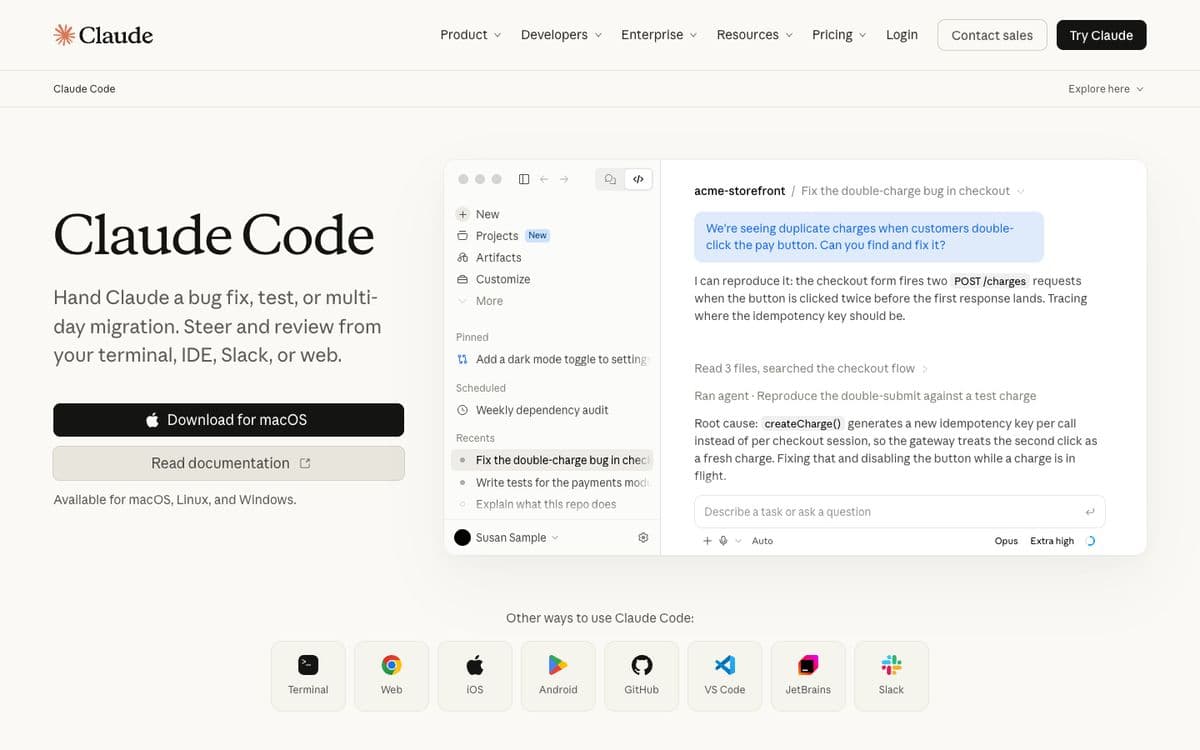
Claude Code is Anthropic's coding agent. You give it a task, from a bug fix to a multi-day migration, and steer it from your terminal, your IDE, Slack or the web. It runs on macOS, Linux and Windows and comes with a Claude subscription. “I've been in ops for 30 years, Claude Code has changed how I work,” linsomniac wrote on Hacker News in March 2026.
Why pick it over Firebase Studio
- Included in Claude Pro and Max, so there's no separate tool to pay for.
- Works on any codebase, with the code on your machine and in your repository.
- If you'd rather not run it yourself, Capacity Desktop runs Claude Code for you on macOS or Windows, and Capacity's web app builds from Claude.ai.
Watch out for
- There's no hosting or database: you deploy and run the app yourself.
- It's built for developers and expects you to review code.
Pricing
Included in Claude Pro: €18/month, or €15/month billed yearly (prices shown in Europe). Max €90/month for 5x Pro's usage, Ultra €180/month for 10x.
Firebase Studio alternatives at a glance From each official site, November 26, 2026.
| Feature |  Firebase Studio | Google AI Studio | Google Antigravity | Capacity | Replit | Bolt.new | Lovable | Cursor | Claude Code |
|---|---|---|---|---|---|---|---|---|---|
| Picks up your code | – | Move now button, or import from GitHub | Zip export and a migration agent | The agent imports a GitHub repository | Import from GitHub | Import from GitHub | Zip import, then a new GitHub repository | Open the folder | Run it in the folder |
| Where you build | Browser | Browser | Desktop app, IDE, CLI | Browser, or Claude and ChatGPT | Browser | Browser | Browser | Desktop editor | Terminal, IDE, web |
| Hosting | Firebase App Hosting | Cloud Run, or App Hosting through GitHub | Firebase App Hosting, published by the agent | Yes, custom domain on every paid plan | Yes, metered deployments | Yes | Yes | No | No |
| Paid plans from | – | Pay as you go | Google AI Pro (€21.99/month) | $25/month | $20/month ($18 yearly) | $25/month | €25/month | $8/month | Claude Pro (€18/month) |
| Free plan | Closed to new users | Yes, the Gemini API free tier | Yes, with a weekly quota | Desktop only (1 project) | None listed | Yes | Yes | Yes | No |
| Built for | Builders and developers on Firebase | Prompt-built apps using Gemini | Developers | Non-technical founders, small businesses | Builders and developers | Makers and developers | Founders, designers, product teams | Developers | Developers |
How to choose an alternative to Firebase Studio. Start from what you need, not from the ranking.
 You built with the App Prototyping agent and want to stay in the browserGoogle AI Studio
 You work in the code and want Google's toolsGoogle AntigravityOff Google's tools, without touching codeCapacity
 An agent and a code workspace in the browserReplit
 A browser builder that imports from GitHubBolt.new
 A chat-to-web-app builderLovable
 Your own editor or terminalCursor or Claude Code
Alternatives to Firebase Studio: questions people ask. Short answers, with the details above.
When does Firebase Studio shut down?
On March 22, 2027. Google announced the sunset on March 19, 2026, and since June 22, 2026 Firebase Studio no longer accepts new workspaces or new users. Until the shutdown you can keep working in existing workspaces and migrate them.
What happens to my Firebase Studio projects?
On March 22, 2027 all remaining data is permanently deleted and can't be recovered. Move or export anything you want to keep before then.
Will my Firestore database and users go away?
No. Only the Firebase Studio development environment shuts down. Cloud Firestore, Firebase Authentication and App Hosting keep working, and your app can keep using the same Firebase project from wherever its code moves.
What does Google recommend instead of Firebase Studio?
Google AI Studio for browser-based, prompt-built apps, especially ones made with the App Prototyping agent, and Google Antigravity for code-first work, templates and imported repositories. You can start in AI Studio and export to Antigravity later.
Can I keep my app's URL?
Yes, if you keep publishing to Firebase App Hosting: through GitHub sync from AI Studio, through Antigravity's publish step, or with the Firebase CLI linked to your existing backend (usually named studio). Publishing to Cloud Run or another host gives the app a new address.
Can I move my Firebase Studio app to a tool outside Google?
Yes. Use Move now → Zip and Download, or export the workspace to GitHub, then open it in a tool that works from code: Capacity's agent imports a GitHub repository and runs it, Replit and Bolt.new import from GitHub, Lovable imports a zip, and Cursor or Claude Code work on the folder. Set your Firebase and Gemini keys as environment variables there.
Is my agent chat history migrated?
No. It isn't part of the exported zip. Google's docs show how to zip the /home/user/.idx/ai folder of your workspace to keep it; Prototyper prompts also appear in the project's git log.
Related comparisons
Try the alternative we build.
Describe your app in a sentence and Capacity builds it, or connect it to Claude or ChatGPT and build from the chat. Plans from $25 a month.