Quick answer
For the same prompt-to-app experience, Bolt.new is the closest switch. Replit suits you if you want an AI agent and a real code workspace in one place, and Base44 has the cheapest entry plan for an all-in-one app with its backend handled.
Capacity, which we make, is for people who want a working app online without touching code, built either from a description or straight from Claude or ChatGPT, with native mobile apps and a custom domain on every paid plan.
Developers who want to own every line are better served by Cursor or Claude Code, and Dyad is the free, open-source option that runs on your own computer.
| Tool | Best for | Paid plans from | Free plan | Watch out for |
|---|---|---|---|---|
| Capacity | non-technical founders who want a real app online, built from a description or from Claude or ChatGPT. | $25/month | Web app: no. Desktop: 1 project | No free plan on the web; login via Clerk, Auth0 or Supabase |
 Bolt.new Bolt.new | a like-for-like switch: prompt to a running web app in the browser. | $25/month | Yes, 1M tokens a month | Token use grows with the project |
 Replit Replit | people who want an AI agent, a real code workspace and hosting in one place. | $20/month | None listed | Agent usage is billed on top |
 Base44 Base44 | non-technical builders who want an all-in-one app with the backend handled. | $16/month (yearly) | Yes, 25 message credits a month | Two kinds of credits to track |
 v0 by Vercel v0 by Vercel | React and Next.js teams who want polished UI and deploy on Vercel. | $30/user/month | Yes, 7 messages a day | Cost depends on the model and tokens |
 Bubble Bubble | apps with heavy business logic that need to scale, built visually. | $29/month (yearly) | Yes | Steeper learning curve |
 FlutterFlow FlutterFlow | native mobile apps designed visually, with code you can download. | $39/month | Yes, up to 2 projects | More of a design tool than a prompt |
 Cursor Cursor | developers who want an AI coding agent in their own codebase. | $8/month | Yes, limited | You need to be comfortable with code |
| Claude Code | developers who want Anthropic's coding agent in their terminal, IDE or browser. | Claude Pro (€18/month) | No | No hosting; built for developers |
 Dyad Dyad | a free, open-source builder that runs on your own computer. | $20/month (Pro) | Yes, free forever | You bring your own AI keys |
Why people look for a Lovable alternative. The reasons that come back most often.
Credits run out on bigger projects
Lovable's Pro plan includes 100 monthly credits. Each change you ask for uses some, and fixing a stubborn bug can take several tries, so busy months cost more than the plan price.
The app outgrows a prototype
Once the app needs a real backend, background jobs or complex permissions, some people want a tool that gives them more control over how it's built and where it runs.
They want the code in their own hands
Developers often prefer to keep the project in their own editor and repository, with an AI agent working on it, instead of inside a hosted builder.
They need a native mobile app
Lovable builds web apps. People who need an app in the App Store or Google Play look at builders that publish native iOS and Android apps.
How we compared them. The same questions for every tool.
- What you get from one sentence: a page, a front end only, or a full app with its data.
- Whether hosting, a database and a custom domain are included, or something you set up yourself.
- Whether you can take your code with you: download, sync to your own GitHub, or not at all.
- Native mobile apps for iOS and Android.
- How you pay: credits, tokens, usage, seats, or a subscription you already have.
- Who it's really built for: non-technical founders, designers, or developers.
01 · our product
Capacity
Best for non-technical founders who want a real app online, built from a description or from Claude or ChatGPT.
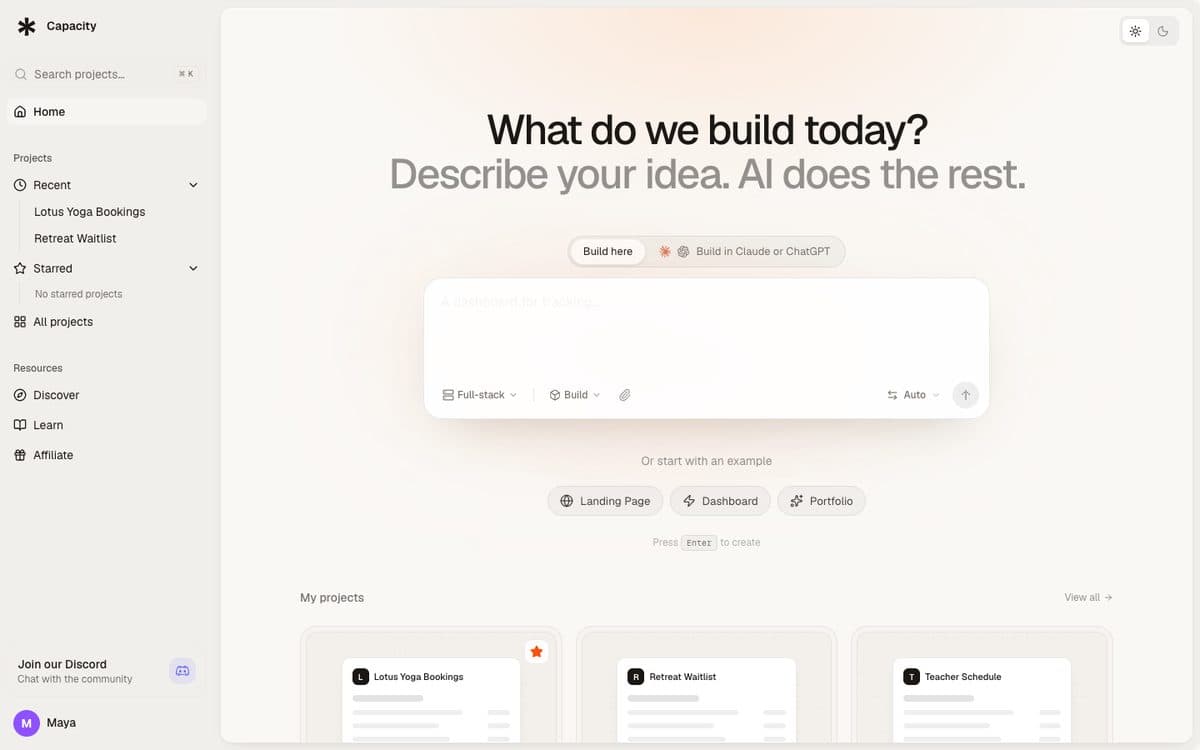
Capacity turns a plain-language description into a working app: a React front end, a server and its own database, published at a capacity.studio address or on your own domain. You change it by chatting, each change shows up in the preview, and any earlier version is one click away. You choose the model (Claude Opus 5.5, Claude Sonnet 5.5, Fable 5.1, Mistral Large 4 or Kimi K3) or leave it on Auto.
Why pick Capacity over Lovable
- Build from the AI you already pay for: connect Capacity to Claude, ChatGPT or Mistral and build from the chat. Your subscription writes the code, Capacity hosts the app, and building this way is unlimited on every paid plan.
- Native mobile apps: Expo projects that you submit to TestFlight and Google Play from the publish dialog, with your own store accounts.
- A custom domain on every paid plan, a full version history, and a website cloner that rebuilds an existing page as a project you keep editing.
- Capacity Desktop ($249 once, macOS and Windows) runs the same builder on your computer with your Claude or ChatGPT plan, and pushes the code to your own GitHub.
Watch out for
- The web app has no free plan for building: paid plans start at $25 a month. Capacity Desktop has a free plan with one project.
- Login isn't built in: you add it with the Clerk or Auth0 extension, or a Supabase connection.
- In the web app, your code downloads as a zip; pushing to your own GitHub is a Desktop feature.
- A younger community and template library than Lovable's.
Pricing
Starter $25/month (100 credits), Growth $69/month (250 credits), Professional $129/month (500 credits), Business $299/month (1,000 credits). Every plan includes unlimited projects, custom domains and unlimited building from Claude and ChatGPT.

02
Bolt.new
Best for a like-for-like switch: prompt to a running web app in the browser.
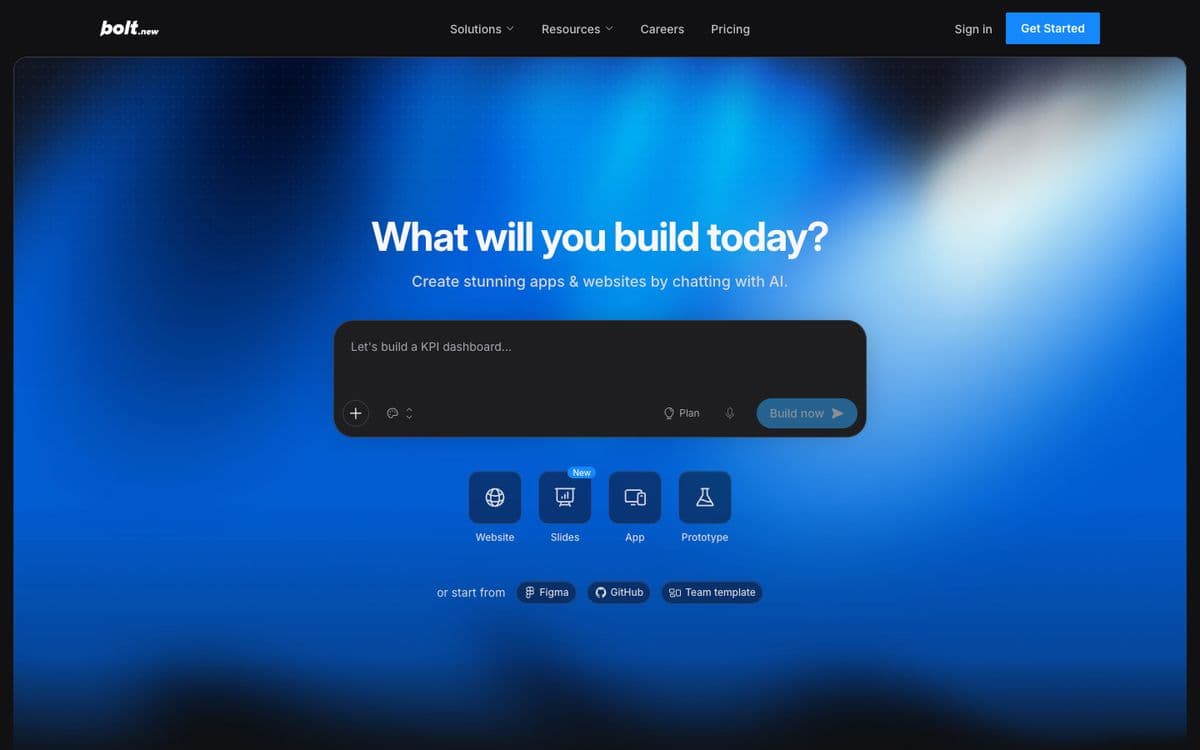
Bolt, from StackBlitz, builds websites and web apps from a chat in your browser and deploys them. It's the tool most comparison guides name first as a Lovable alternative, because the experience is the closest: describe it, watch it build, publish.
Why pick it over Lovable
- The workflow is almost the same as Lovable's, so there's little to relearn.
- You can start from a prompt, a Figma file, a GitHub repository or a team template.
- On Pro, unused tokens roll over to the next month.
Watch out for
- Billing is in tokens, and long fix-and-retry sessions on a large project use them up faster.
- The free plan stops at 300K tokens a day and 1M a month.
Pricing
Free: 300K tokens a day, 1M a month. Pro: $25/month, no daily limit, from 10M tokens a month, unused tokens roll over. Teams: $30 per member per month.

03
Replit
Best for people who want an AI agent, a real code workspace and hosting in one place.
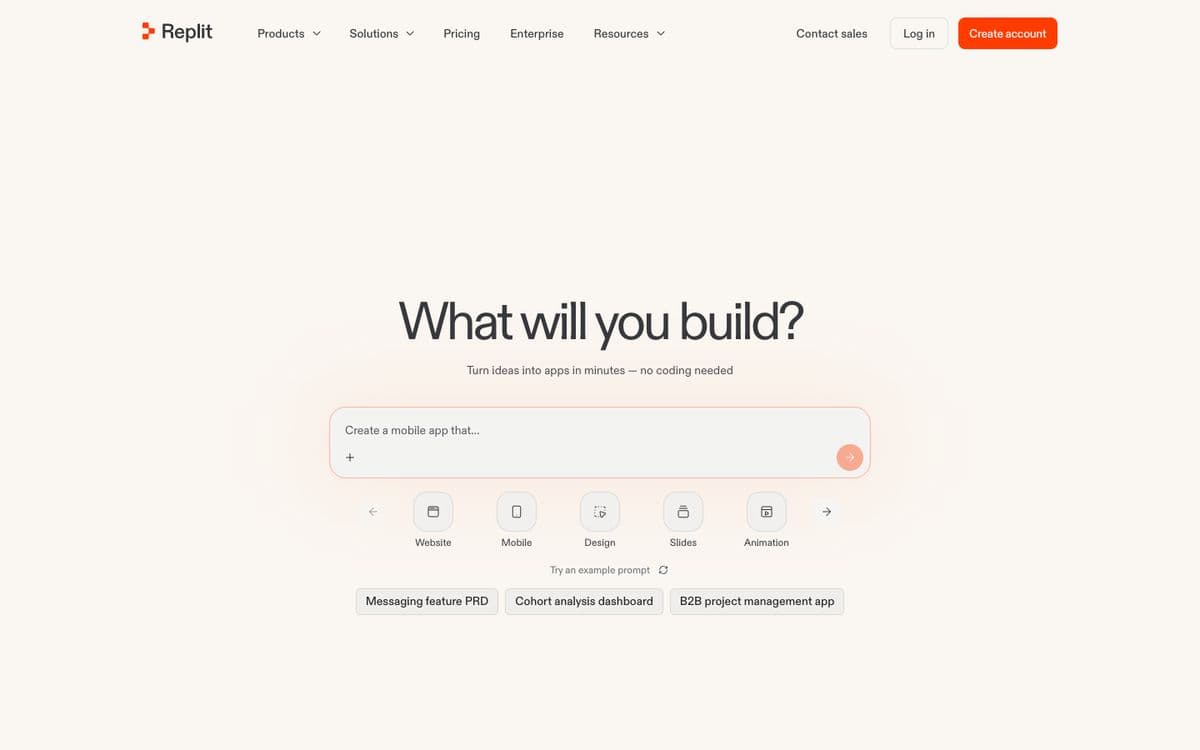
Replit pairs its Agent, which builds apps from a description, with a full cloud workspace: editor, database, hosting and deployment. You can stay in the chat, or open the code whenever you want to change something yourself. It builds websites and mobile apps.
Why pick it over Lovable
- Everything from the first prompt to hosting lives in one product.
- You can move into the code as you learn, without leaving the tool.
- A Plan mode and up to ten agents working in parallel on the Pro plan.
Watch out for
- Heavier work is billed by effort beyond the credits in your plan, so a long build is hard to price in advance.
- The workspace shows more of the technical side than Lovable does, which can be a lot for non-technical founders.
Pricing
Core: $20/month ($18/month billed yearly), with up to 30 hours of chat on Free Mode and $20 of usage for the more powerful models. Pro: $100/month ($90/month billed yearly). Enterprise on request. No free plan is listed on the pricing page.

04
Base44
Best for non-technical builders who want an all-in-one app with the backend handled.
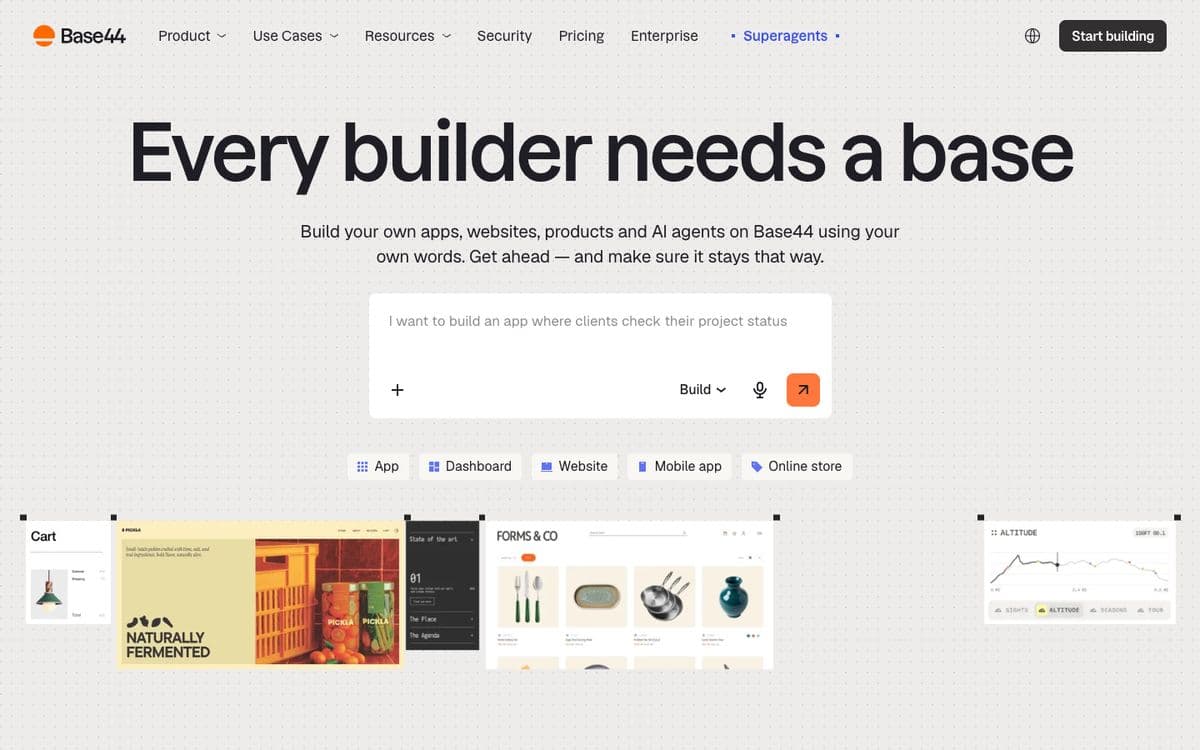
Base44 builds the front end, backend, database, user login and payments from a plain-language description, runs the apps on its own infrastructure, and connects to tools like Gmail, Slack, Notion and HubSpot. It makes websites, internal tools, online stores and mobile apps.
Why pick it over Lovable
- The lowest entry price on this list: Starter is $16 a month billed yearly.
- Login and payments are part of what it builds, not an add-on.
- A free domain for a year on paid plans.
Watch out for
- Plans count two kinds of credits, message credits and integration credits, so check both before a busy month.
- GitHub integration starts on the Builder plan ($40 a month billed yearly).
Pricing
Free: 25 message credits a month. Billed yearly: Starter $16/month (100 message credits), Builder $40 (250), Pro $80 (500), Elite $160 (1,200). Monthly billing costs about 20% more.

05
v0 by Vercel
Best for React and Next.js teams who want polished UI and deploy on Vercel.
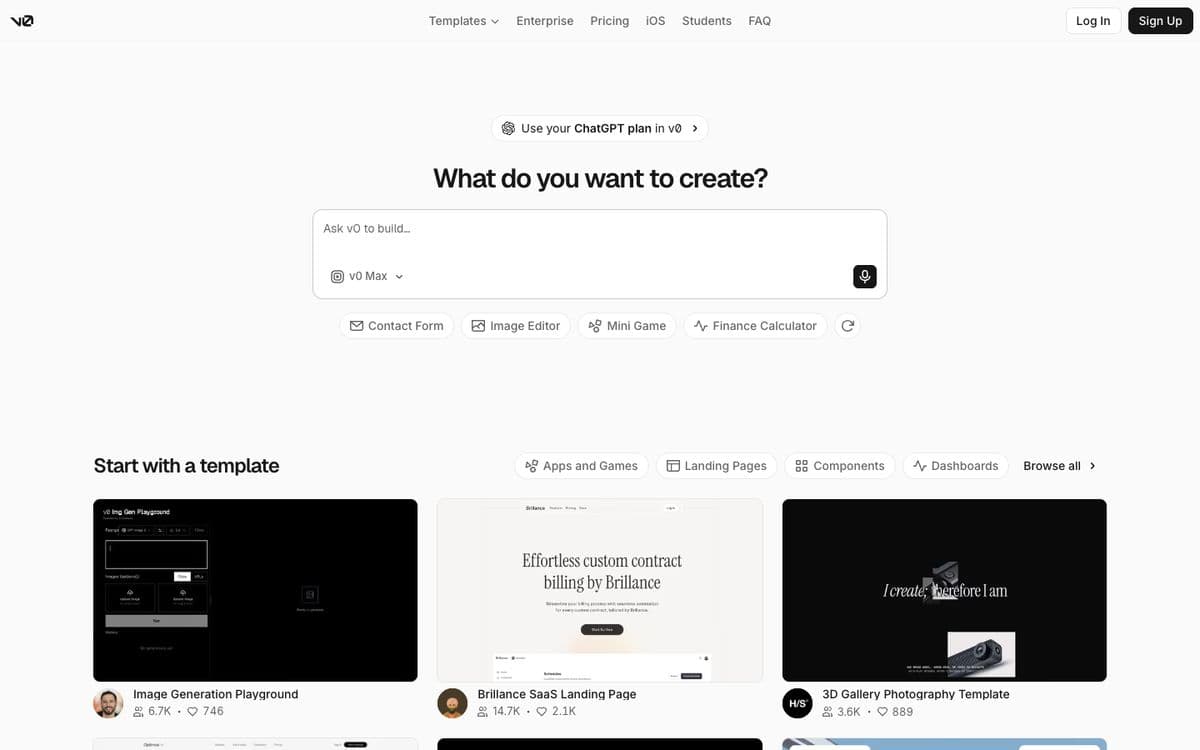
Vercel's v0 builds web apps and interfaces from a prompt, with a visual Design Mode, GitHub sync and one-click deploys to Vercel. It's known for clean React and Tailwind output that developers can drop into an existing codebase.
Why pick it over Lovable
- Some of the most polished interface code of any tool here.
- GitHub sync and deploys to Vercel on every plan, including the free one.
- Teams share chats and billing on vercel.com.
Watch out for
- The free plan gives $5 of one-time credits, then 7 messages a day.
- Usage is billed by tokens at each model's rate, so cost depends on the model you pick.
- It assumes you're comfortable around React and Vercel.
Pricing
Free: $5 of one-time credits, 7 messages a day. Plus: $30 per user per month, with $30 of monthly credits and $2 of free daily credits. Business: $100 per user per month.

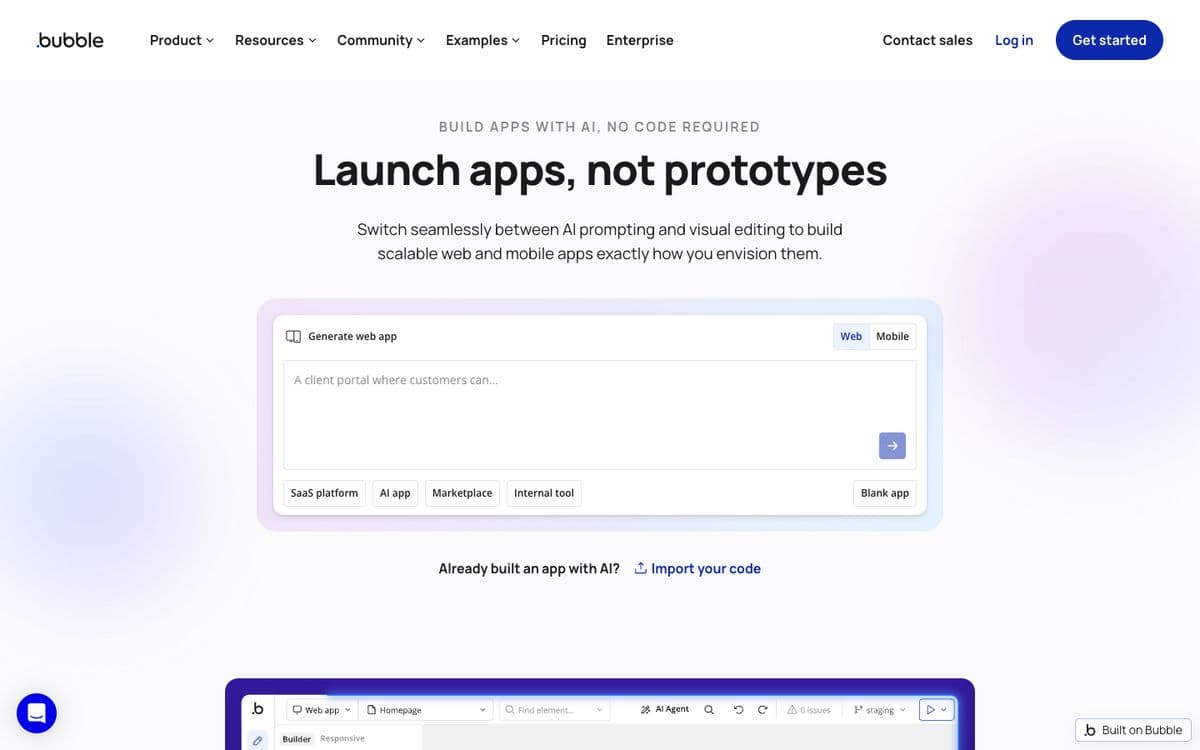
Bubble is the long-standing visual app builder. It now starts from an AI prompt and lets you switch between prompting and editing visually, for web, iOS and Android apps, with its own database and workflows.
Why pick it over Lovable
- Deep control over data, workflows and permissions, which suits complex products.
- Web and native mobile apps from the same plan.
- Generating an app from a prompt doesn't use AI credits.
Watch out for
- It takes longer to learn than prompt-only builders.
- Usage is measured in workload units, which grow with your app's traffic.
Pricing
Free plan to build. Billed yearly: Starter $29/month, Growth $119/month, Team $349/month, each with more AI credits and workload units.

07
FlutterFlow
Best for native mobile apps designed visually, with code you can download.
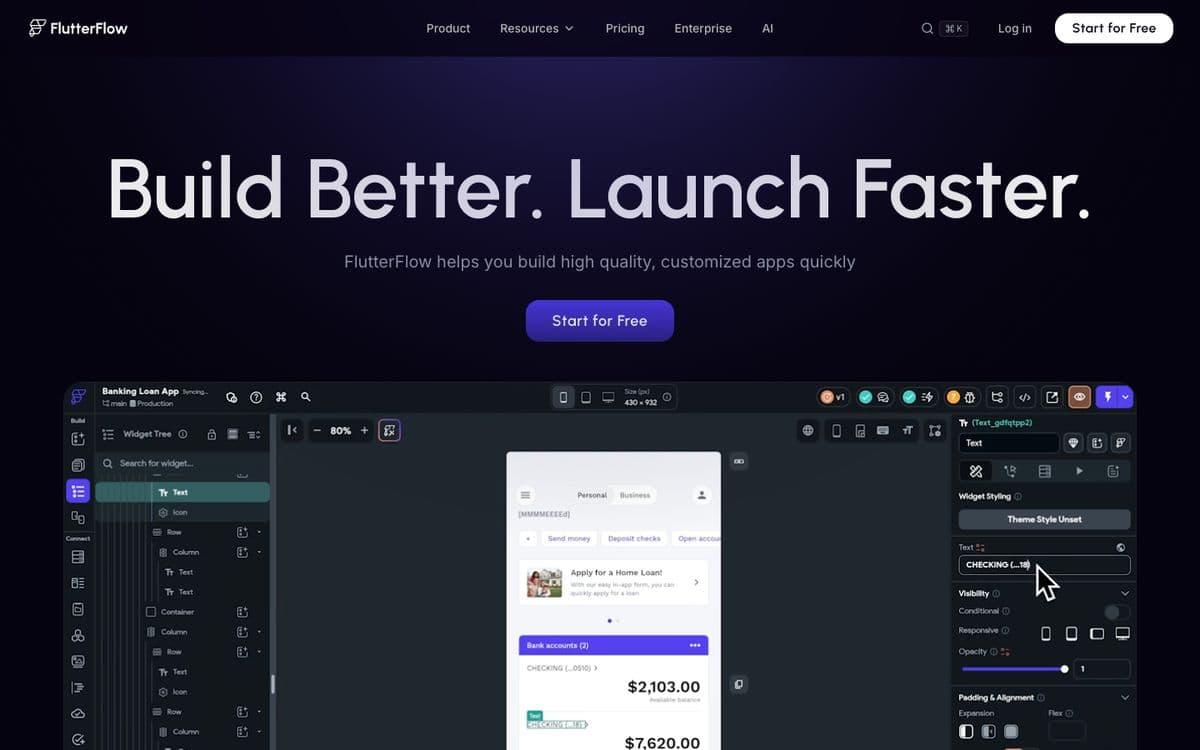
FlutterFlow builds Flutter apps for iOS, Android and the web in a visual editor, with AI to generate pages and components. It's the usual pick when the native mobile app is the product.
Why pick it over Lovable
- Strong native mobile results with fine control over every screen.
- Download the project's source code or an APK from the Basic plan.
- Push to GitHub and work in VS Code on higher plans.
Watch out for
- You build screen by screen in an editor, so it asks more of you than a prompt-to-app tool.
- Team plans are priced per seat.
Pricing
Free: up to 2 projects. Basic: $39/month. Growth: $80/month for the first seat, $55 for the second. Business: $150/month for the first seat.

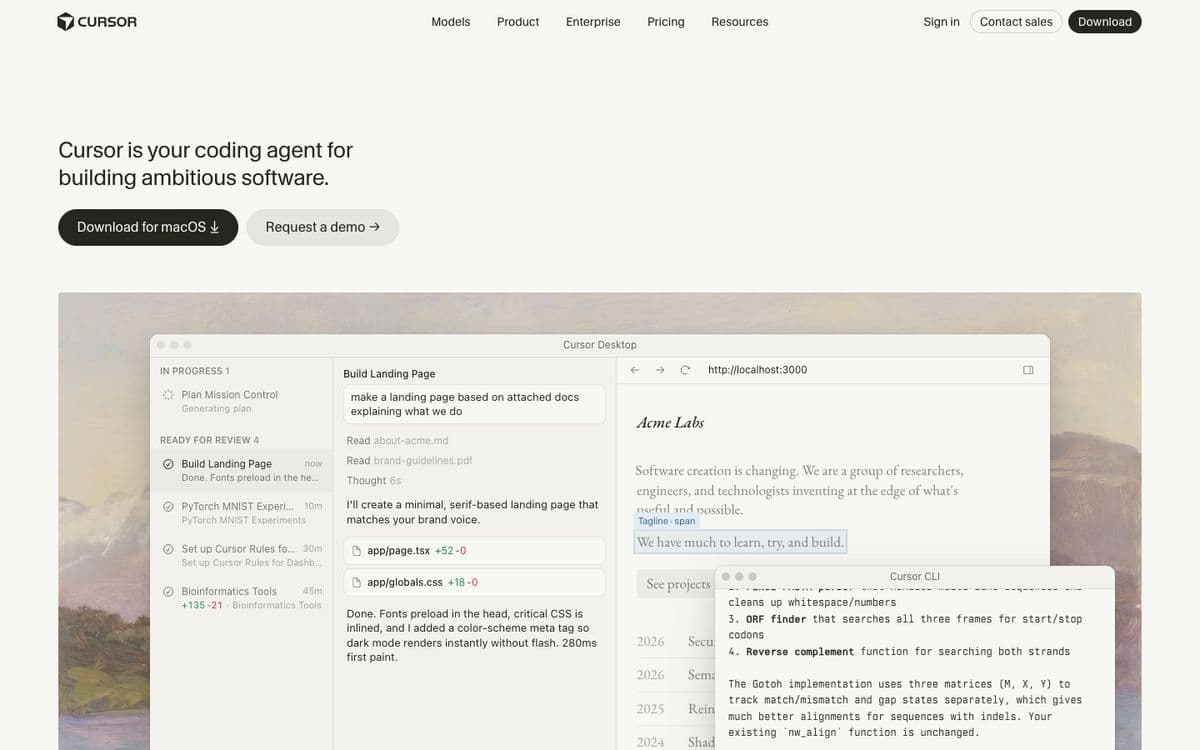
Cursor is a code editor built around AI agents. You open your project, describe the change, and the agent edits the files; you review and keep what works. Its plans now bundle Grok models and features from X.
Why pick it over Lovable
- Your code stays on your machine and in your repository.
- Works on any stack, not only the ones a hosted builder supports.
- Cloud agents and automations on the higher plans.
Watch out for
- It's a developer tool: there's no hosting, and you deploy the app yourself.
- The plans mix AI usage with Grok and X features, so read what each tier includes.
Pricing
Free with limited AI usage. Plus $8/month, Premium $30/month (4x more usage than Plus), Super $100/month, Ultra $200/month. Teams from $30 per user per month.
09
Claude Code
Best for developers who want Anthropic's coding agent in their terminal, IDE or browser.
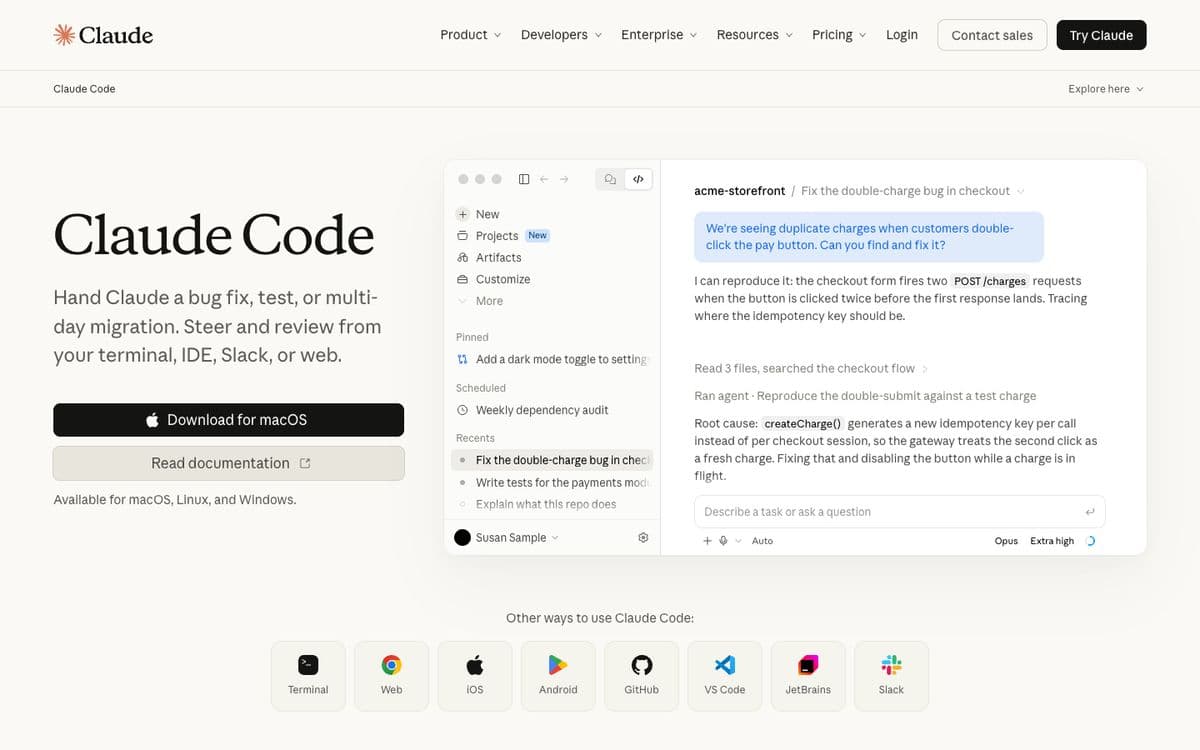
Claude Code is Anthropic's coding agent. You give it a task, from a bug fix to a multi-day migration, and steer it from your terminal, your IDE, Slack or the web. It runs on macOS, Linux and Windows and comes with a Claude subscription.
Why pick it over Lovable
- Included in Claude Pro and Max, so there's no separate tool to pay for.
- Works on any codebase, with the code on your machine and in your repository.
- If you'd rather not run it yourself, Capacity Desktop runs Claude Code for you on macOS or Windows, and Capacity's web app builds from Claude.ai.
Watch out for
- There's no hosting or database: you deploy and run the app yourself.
- It's built for developers and expects you to review code.
Pricing
Included in Claude Pro: €18/month, or €15/month billed yearly (prices shown in Europe). Max from €90/month for 5x or 20x more usage.

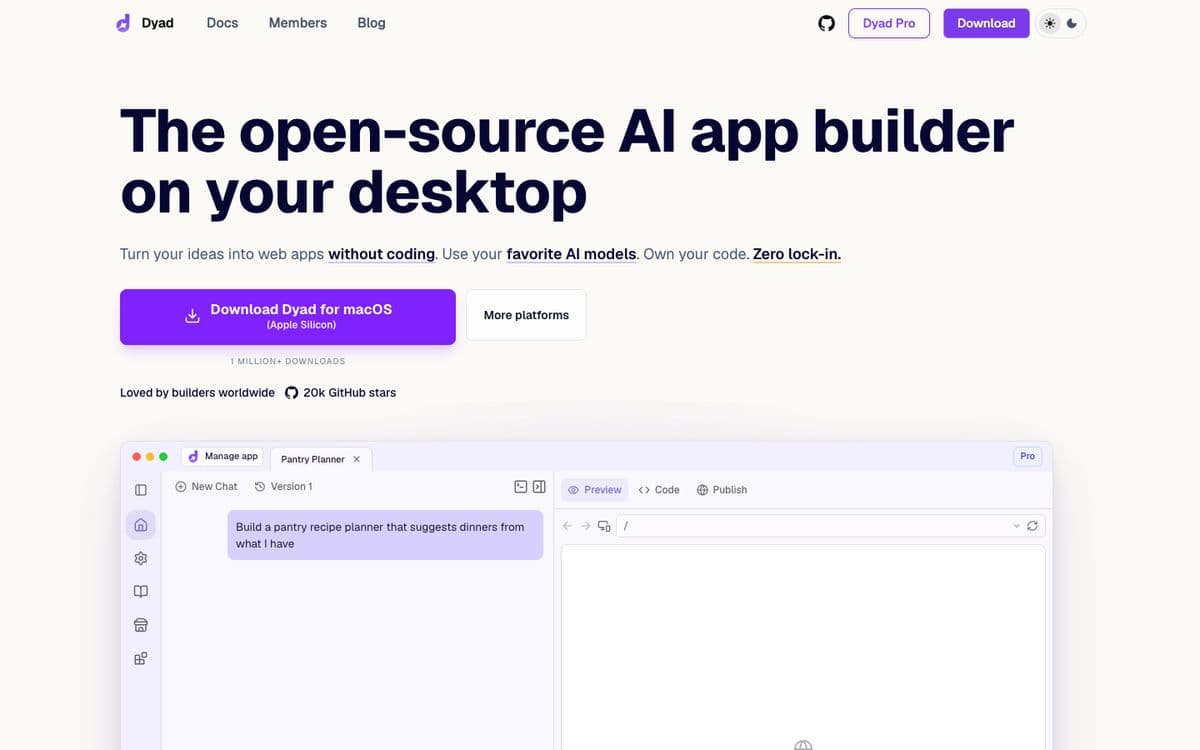
Dyad is an open-source app builder you install on your desktop. You describe the app, it builds it locally with the AI models you choose, and the code stays yours with no lock-in.
Why pick it over Lovable
- Free forever if you use your own API keys from an AI provider.
- Open source, and the project lives on your machine.
- Pro adds an agent that tests and fixes bugs on its own.
Watch out for
- Setting up API keys and publishing the app is on you.
- Like any local tool, it runs only on the computer where it's installed.
Pricing
Free with your own API keys. Pro: $20/month (200 AI credits). Max: $79/month (900 AI credits).
Lovable and its alternatives, side by side. From each official site, October 15, 2026.
| Feature |  Lovable Lovable | Capacity | Bolt.new | Replit | Base44 | v0 by Vercel | Bubble | FlutterFlow | Cursor | Claude Code | Dyad |
|---|---|---|---|---|---|---|---|---|---|---|---|
| Paid plans from | €25/month | $25/month | $25/month | $20/month | $16/month (yearly) | $30/user/month | $29/month (yearly) | $39/month | $8/month | €18/month (Claude Pro) | $20/month |
| Free plan | Yes | Desktop only (1 project) | Yes | None listed | Yes | Yes | Yes | Yes | Yes | No | Yes, with your own keys |
| How usage is billed | Monthly credits | Monthly credits; building from Claude or ChatGPT unlimited | Tokens | Plan credits plus effort-based usage | Message and integration credits | Credits spent at each model's token rate | AI credits and workload units | Per seat | AI usage pools, bundled with Grok and X | Your Claude subscription | Your own API keys, or credits |
| Hosting included | Yes | Yes, custom domain on every paid plan | Yes | Yes | Yes | Yes, on Vercel | Yes | Web publishing | No | No | No |
| Native mobile apps | No | Yes (Expo, TestFlight and Google Play) | – | Yes | Yes | No | Yes (iOS and Android) | Yes (Flutter) | If you code it | If you code it | No |
| Taking your code with you | GitHub sync | Zip download; GitHub push from Desktop | Import from GitHub | Full access in the workspace | GitHub from the Builder plan | GitHub sync on every plan | No code export | Code download from Basic, GitHub from Growth | Your own repository | Your own repository | On your computer |
| Built for | Founders, designers, product teams | Non-technical founders, small businesses | Makers and developers | Learners and developers | Non-technical builders | React developers and designers | No-code builders with complex apps | Mobile app teams | Developers | Developers | Tinkerers and developers |
How to choose. Start from what you need, not from the ranking.
 The same experience, different pricingBolt.newA working app online without touching codeCapacityBuilding from Claude or ChatGPTCapacity
 AI plus a real code workspaceReplit
 The lowest entry priceBase44
 Polished React interfacesv0 by Vercel
 Complex logic, built visuallyBubble
 A native mobile app firstFlutterFlow or Capacity
 Every line of code in your repositoryCursor or Claude Code
 Free, local and open sourceDyad
When to stay on Lovable
If your app is a web prototype or a small product and the credits cover your month, Lovable's speed from idea to demo is hard to beat, and its GitHub sync keeps the code within reach. Switching makes sense when the cost, the need for a native app, or the need for control outweighs that.
Questions people ask. Short answers, with the details above.
What is the best alternative to Lovable?
It depends on why you're leaving. Bolt.new is the closest like-for-like tool, Replit suits people who want an AI agent with a real code workspace, Base44 has the lowest entry price, and Capacity suits non-technical founders who want a working app online, including from Claude or ChatGPT. Developers who want full control use Cursor or Claude Code.
Is there a free Lovable alternative?
Yes. Dyad is free and open source if you use your own AI API keys, and Bolt.new, Base44, v0, Bubble and FlutterFlow all have free plans with limits. The Capacity web app has no free plan for building; Capacity Desktop has a free plan with one project.
What's cheaper than Lovable?
On entry price, Base44's Starter plan is $16 a month billed yearly and Replit Core is $18 a month billed yearly, against €25 a month for Lovable Pro. What you actually pay depends on how many credits or tokens your project uses.
Lovable vs Bolt: which one should I use?
They're close. Both turn a prompt into a web app you can publish. Lovable counts credits per message; Bolt counts tokens, has a daily limit on its free plan, and on Pro rolls unused tokens over to the next month. Try the same prompt in both and compare the result and the cost.
Lovable vs Replit for a non-technical founder?
Lovable keeps you in a chat and a preview. Replit gives you the same chat plus a full code workspace, database and hosting, which is more powerful but shows more technical detail. If you never want to see code, Lovable, Capacity or Base44 are gentler.
Base44 vs Lovable, which is better for a SaaS?
Base44 builds login and payments as part of the app and starts cheaper; Lovable runs on a Postgres backend and syncs to GitHub on every plan, which makes it the safer base for a SaaS you plan to grow. Our full Base44 vs Lovable comparison goes through backend, pricing, code ownership and mobile.
Can I move my Lovable project to another tool?
Lovable syncs your code to GitHub, so a tool that works from a repository (Cursor, Claude Code, Replit, or Bolt importing from GitHub) can pick it up. Hosted builders like Capacity or Base44 usually rebuild the app from a description rather than import the code.
Is there a Lovable alternative for native mobile apps?
Yes. FlutterFlow and Bubble build native iOS and Android apps, and Capacity builds Expo apps that you submit to TestFlight and Google Play from its publish dialog. Lovable itself builds web apps.
Is there a Lovable alternative that works from Claude or ChatGPT?
Capacity connects to Claude, ChatGPT and Mistral: you ask for an app in the chat, your subscription writes the code and Capacity hosts it, versions it and puts it on your domain. It needs a paid Capacity plan.
Is there a desktop app like Lovable that runs on Claude Code?
Capacity Desktop is a macOS and Windows app that works like Lovable on top of your Claude Code or ChatGPT subscription, for $249 once (its free plan covers one project), and pushes your code to your own GitHub. Dyad is a free, open-source desktop builder that uses your own API keys.
Related comparisons
Try the alternative we build.
Describe your app in a sentence and Capacity builds it, or connect it to Claude or ChatGPT and build from the chat. Plans from $25 a month.