

Capacity vs Durable
Looking for a Durable alternative?
Discover why you need an app builder, not a website generator.
Durable builds business websites in 30 seconds. Capacity builds full-stack web applications with real code. This guide explains which tool is right for your needs in 2025.
Capacity builds applications
vs Durable's websites
Code ownership with Capacity
vs Durable's locked platform
Both offer free tiers
Capacity $0 to start
What is Durable?
Durable Durable is an AI-powered website builder that generates small business websites in 30 seconds. Launched in 2022, it targets solopreneurs and small business owners who need a quick online presence with built-in CRM, invoicing, and marketing tools.
Durable Key Features
- 30-second website generation from business info
- Built-in CRM and invoicing for small businesses
- AI content generation (blog posts, ads, social)
- 10 million stock photos and AI image generation
- Built-in SEO and hosting with custom domains
Durable Limitations
- No code export - you're locked to their platform
- Cannot build real applications, only websites
- No database beyond basic CRM functionality
- Limited customization - template regeneration only
- No user authentication or API capabilities
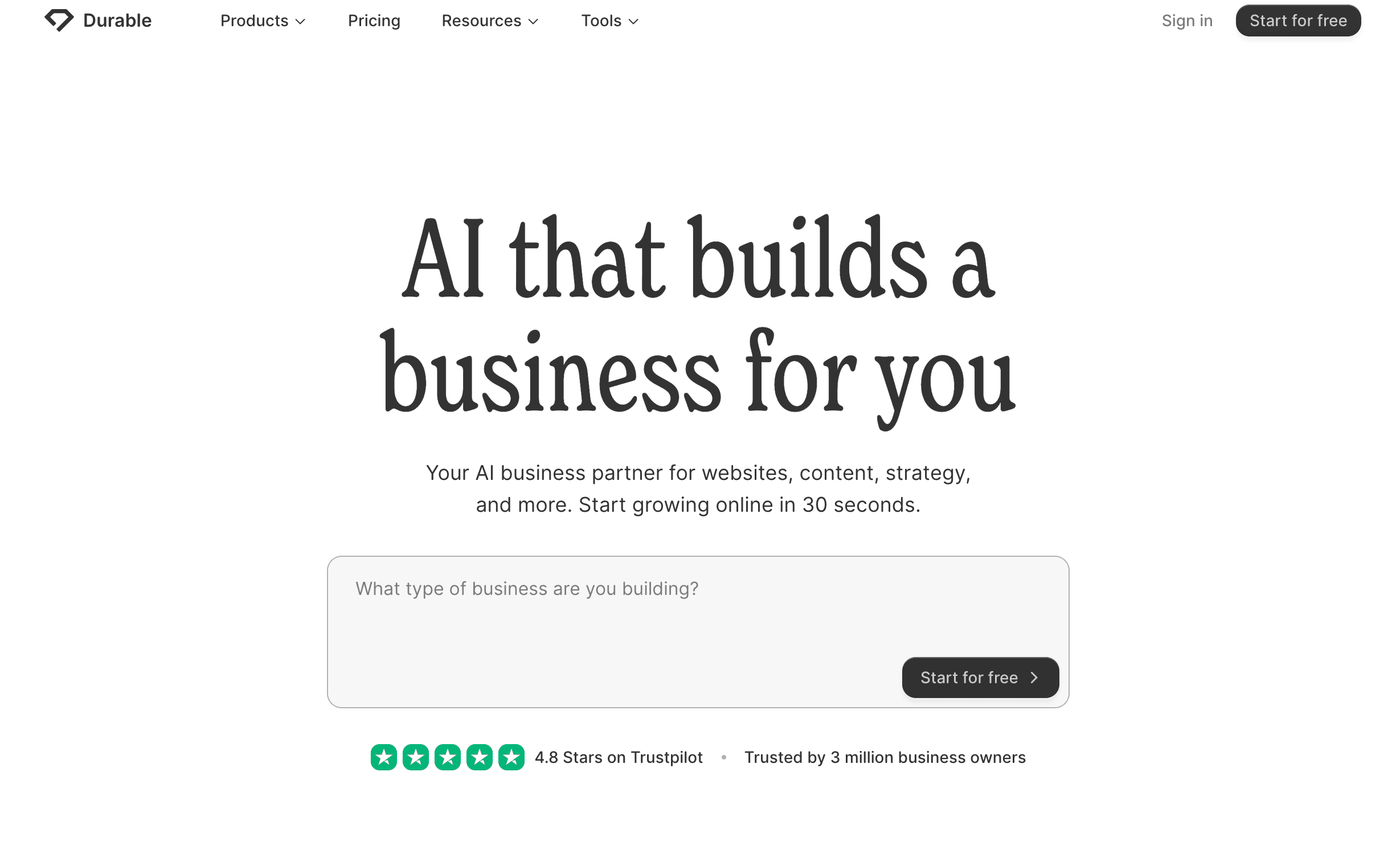
Durable Review: A Detailed Look
Durable has built an impressive product for its specific use case: getting small businesses online quickly. Enter your business type, name, and location, and you'll have a professional-looking website in under a minute. The AI writes your copy, selects appropriate stock images, and handles SEO basics automatically.
For a local plumber, photographer, or consultant who just needs a web presence with contact information, Durable is genuinely useful. The built-in CRM and invoicing features add real value for service businesses. It's trusted by millions of small business owners with a 4.8-star rating on Trustpilot.
However, Durable is fundamentally a website builder, not an application builder. If you need user accounts, a real database, custom business logic, or any functionality beyond a marketing website - Durable simply cannot help. There's no code to export, no way to add custom features, and no path to building a real product. For that, you need a different category of tool entirely.
Why Choose Capacity Over Durable
Capacity builds real web applications, not just websites.
True Full-Stack Apps
Unlike Durable's static websites, Capacity builds complete applications with frontend, backend, database, and authentication - everything you need for a real product.
- React + Next.js frontend
- Supabase PostgreSQL database
- User authentication built-in
- API routes ready to use
Full Code Ownership
Durable locks your website on their platform with no export. Capacity generates standard code you completely own - deploy anywhere, modify anything.
- GitHub integration
- Export and self-host anywhere
- Modify code directly
- No vendor lock-in
Spec-First Development
Durable generates from minimal input (business name/type). Capacity uses comprehensive specifications for precise, customized applications.
- Detailed project briefs
- UX specifications
- Design system definitions
- User story management
Developer Experience
Capacity provides a real development environment with live preview, code editing, and instant feedback - not just template regeneration.
- Hot reload as you code
- Real code editor access
- Debug in real-time
- AI co-founder assistance
How Capacity Works
A step-by-step look at building real applications
Write Your Project Brief
Start by describing your application at a high level. What problem does it solve? Who is it for? What are the core features? Unlike Durable's 3-field input, Capacity helps you think through your product properly with AI co-founder guidance.
Define User Experience
Map out user flows, interactions, and the overall experience you want to create. Define how users will navigate your app, what actions they'll take, and what outcomes they'll achieve. Real application planning that a website generator can't do.
Specify Design Requirements
Document your visual preferences, brand guidelines, and design system. Unlike Durable's preset palettes, Capacity lets you define exactly how your application looks and feels with a complete design system.
Create User Stories
Break down your features into user stories - specific, implementable tasks. Each story becomes a clear instruction for the AI, ensuring nothing gets lost in translation. This is application development, not website templating.
Generate, Deploy, Iterate
With your specifications complete, AI generates production-ready code. Deploy instantly to your custom domain, connect to GitHub for version control, and iterate by updating your specs. Real development workflow.
Feature-by-Feature Comparison
See how Capacity stacks up against Durable across key features
| Feature | Capacity | Durable |
|---|---|---|
| Full-Stack Apps | ||
| AI Code Generation | ||
| Spec-First Development | ||
| Supabase database integration | ||
| Code Export | ||
| GitHub Integration | ||
| User Authentication | ||
| API Routes | ||
| User Story Management | ||
| Real-time Live Preview | ||
| Custom Domains | ||
| Built-in Hosting | ||
| SEO Optimization | ||
| AI Content Generation | ||
| Built-in CRM | ||
| Invoicing System | ||
| Marketing Automation | ||
| 30-Second Website |
What Can You Build with Capacity?
Real applications that a website builder like Durable cannot create
SaaS Dashboard
Build a complete SaaS application with user authentication, subscription management, admin dashboard, and analytics. Durable can't build this - Capacity's spec-first approach ensures all user roles, permissions, and data flows are clearly defined.
E-commerce Platform
Create a full-featured online store with product catalog, shopping cart, checkout flow, and order management. Beyond a simple landing page - a real e-commerce application that Durable's website builder cannot create.
Internal Tools
Build custom internal tools for your team - CRMs, inventory systems, project trackers, or data dashboards. Define your workflows and data models in specifications for precise implementation.
Client Portals
Create branded client portals with secure login, document sharing, project tracking, and communication features. Requires real user authentication and data management that website builders can't provide.
Pricing Comparison
Both offer free tiers, but for very different purposes
Capacity- Build real web applications
- Full code ownership & GitHub export
- Supabase database integration
- Credit-based flexible pricing
- Hosting included
Durable- Starter: $15/mo - basic website features
- Business: $25/mo - CRM & invoicing
- Scale: $99/mo - multi-business support
- Free tier: 3 pages, subdomain only
- No code export at any tier
Website Builder vs App Builder
Understanding the fundamental difference between Durable and Capacity
Durable: Website BuilderTemplate-Based Websites
"Business type + name + location"
AI generates from templates in 30 seconds
Static marketing website with contact forms
- No user accounts or authentication
- No database for storing app data
- No custom business logic
Capacity: App BuilderSpec-First Applications
Comprehensive specs: Brief + UX + Design + Stories
AI generates precise, custom code
Full-stack application you own completely
- Complete user authentication
- Real PostgreSQL database
- Custom logic and API routes
How to Build Real Apps with Capacity
When you need more than a website, here's how to get started
Identify What You Actually Need
Determine if you need just a marketing website (Durable might be fine) or a real application (you need Capacity). Most people looking to migrate need actual app functionality.
Create Your Project Brief in Capacity
Start fresh with Capacity by creating a comprehensive project brief. Describe your product vision, target users, core features, and business goals. The AI co-founder will help you refine this.
Define User Experience Specifications
Map out your user flows, page structure, and interactions. This is where Capacity shines - you're explicitly defining how users will navigate and use your application.
Set Up Design Specifications
Configure your design system including colors, typography, spacing, and component styles. Create a cohesive design that reflects your brand.
Create User Stories
Break down your features into user stories. Each story becomes a clear, implementable task that the AI can execute precisely based on your specifications.
Generate and Deploy
With your specifications complete, let Capacity's AI generate production-ready code. Connect to GitHub, deploy to your custom domain, and you're live with a real application.
Who Should Choose Capacity?
Capacity is the right choice when you need more than a website.
Startup Founders
Building MVPs that need real functionality - user auth, databases, and custom logic.
Technical Teams
Developers who want AI assistance without sacrificing code quality or architecture.
SaaS Builders
Creating subscription-based applications with user management and billing integration.
Enterprise Projects
Teams that need structured documentation, code ownership, and deployment flexibility.
App Creators
Those building interactive applications, not just static marketing websites.
Fast Iterators
Builders who want to quickly update specs and regenerate code without starting over.
Technical Comparison
A deeper look at the technical differences between platforms
Tech Stack
Capacity
- React 18 + Next.js 14
- TypeScript for type safety
- Tailwind CSS for styling
- Supabase (PostgreSQL, Auth, Realtime)
Durable
- Proprietary website system
- No access to underlying code
- Template-based rendering
Deployment Options
Capacity
- One-click deploy to Capacity hosting
- GitHub integration for CI/CD
- Export and self-host anywhere
- Custom domains with auto SSL
Durable
- Durable hosting only (locked)
- No code export option
- Custom domains supported
Database & Backend
Capacity
- Supabase PostgreSQL
- Row-level security
- Real-time subscriptions
- Edge functions
- Built-in authentication
Durable
- Built-in CRM (contacts only)
- Invoicing data storage
- No general-purpose database
Customization & Ownership
Capacity
- Full code ownership
- Spec-based customization
- Direct code editing
- Complete design control
Durable
- Template regeneration only
- Preset color palettes
- Limited section editing
- No code access
Frequently Asked Questions
Common questions about Capacity vs Durable
What's the difference between Capacity and Durable?
The fundamental difference is category. Durable is a website builder designed for small business marketing sites - it generates landing pages, portfolios, and business websites in 30 seconds. Capacity is an application builder designed for full-stack web applications - it generates React/Next.js code with databases, authentication, and custom business logic. If you need a simple business website, Durable might work. If you're building an actual application with user accounts and data, you need Capacity.
Is Durable good for building web apps?
No. Durable is specifically designed for static and semi-static business websites. It has no code generation, no database integration beyond basic CRM, no user authentication system, and no API capabilities. It's great for getting a small business online quickly, but it cannot build functional web applications. For apps, you need a true application builder like Capacity.
Can I export code from Durable?
No, Durable does not offer code export. Your website lives entirely on their platform with no way to self-host or customize the underlying code. Capacity, on the other hand, generates standard React/Next.js code that you fully own, can export to GitHub, and deploy anywhere.
Which is better for startups?
It depends on what you're building. If you just need a landing page to validate an idea, Durable's 30-second website generation could be useful for a quick marketing site. But if you're building an actual product - an MVP with user accounts, data storage, and business logic - Capacity is the right choice. Most startups need real applications, not just marketing websites.
Does Capacity support small business websites?
Yes! Capacity can build any type of web application, including marketing websites. However, if all you need is a simple business landing page with contact forms and basic information, Durable's template-based approach might be faster. Capacity shines when you need more: user authentication, databases, custom functionality, or the ability to own and modify your code.
How does pricing compare?
Both platforms offer free tiers. Durable starts at $15/month for their Starter plan, going up to $99/month for Scale. Capacity offers a free tier with credit-based flexible pricing - you only pay for what you use. For serious application development, Capacity provides significantly more value since you get full code generation, database integration, and GitHub connectivity.
What about database capabilities?
Durable includes a basic CRM for contact management, but no real database for building applications. Capacity integrates with Supabase, giving you a full PostgreSQL database with row-level security, real-time subscriptions, edge functions, and proper authentication. This is essential for building real applications.
Can I migrate from Durable to Capacity?
Since Durable doesn't export code, migration means starting fresh in Capacity. However, this is often a good thing - you'll be building a proper application rather than trying to extend a template-based website. Use Capacity's spec-first approach to properly define your requirements and build a production-ready application.
Which has better customization?
Capacity offers far more customization. With Durable, you're limited to regenerating sections with different AI tones and choosing from preset color palettes. With Capacity, you define comprehensive specifications (project brief, UX, design system, user stories) and generate custom code that you can further modify directly. Plus, you own the code.
Do either support mobile apps?
Durable creates responsive websites that work on mobile browsers. Capacity currently focuses on web applications built with React and Next.js - all generated apps are fully responsive. Neither currently builds native iOS/Android apps, though Capacity's roadmap includes this for future releases.
What tech stack does each use?
Durable uses a proprietary system - you don't see or control the underlying technology. Capacity generates modern, production-ready code using React 18, Next.js 14, TypeScript, and Tailwind CSS for the frontend, with Supabase (PostgreSQL, Auth, Realtime) for the backend. This gives you a battle-tested, scalable tech stack.
Who should use Durable vs Capacity?
Use Durable if: You need a quick business landing page, you don't care about code ownership, and you want built-in CRM/invoicing for a small service business. Use Capacity if: You're building an actual application, you want code you can own and modify, you need a database and user authentication, or you're creating a startup MVP.
The Bottom Line: Capacity vs Durable
Capacity and Durable are fundamentally different tools for different purposes. Durable is excellent at what it does - generating quick business websites for small companies that need a basic online presence with CRM and invoicing features.
Capacity is for a completely different use case: building real web applications with user authentication, databases, custom logic, and code you actually own. If you're building a SaaS product, an MVP for investors, or any application with actual functionality - you need an app builder, not a website generator.
The key question is: do you need a marketing website or a functional application? If you're reading this comparison, you likely need the latter - and that's exactly what Capacity is built for.