

Capacity vs Same.new
Specification-first development vs. vibe coding
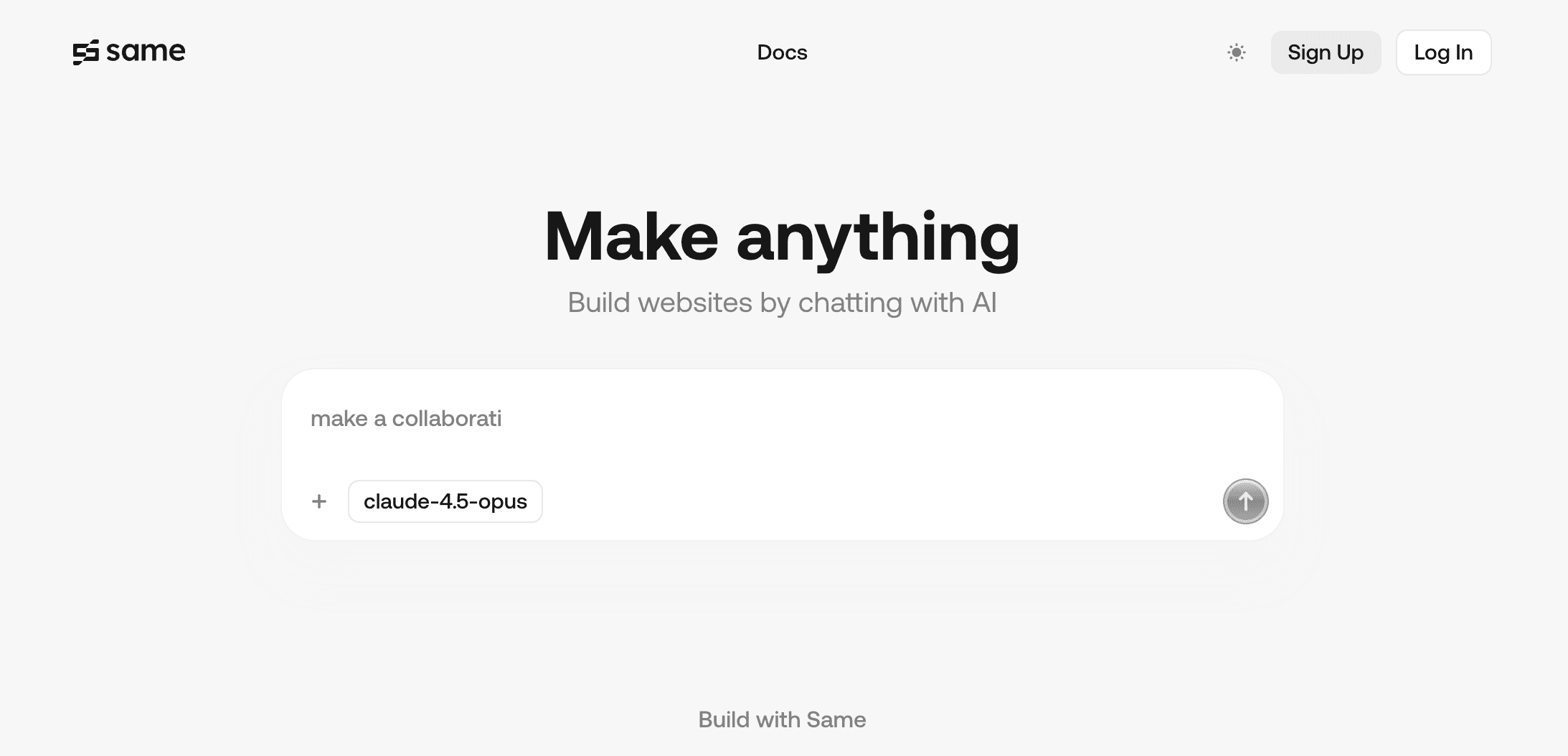
Looking for a Same.new alternative? Same.new is an AI-powered platform that generates full-stack web applications by cloning existing websites from URLs or through text prompts, using Next.js as its foundation.
Build unique apps from specs, not clones of existing sites
Stable platform with proper GitHub version control
No token anxiety or credit loss from failed attempts
What is Same.new?
Same.new is an AI-powered platform that generates full-stack web applications by cloning existing websites from URLs or through text prompts, using Next.js as its foundation.
Strengths
- URL-based cloning - replicate sites from a single URL
- Full-stack generation with Next.js and TypeScript
- Prompt-driven customization for layouts and styles
- One-click deployment to hosting platforms
- Code export for Next.js and static sites
Same.new Limitations
- No spec-first methodology - relies on cloning or prompts
- Reliability concerns - users report freezing and data loss
- Token-based pricing with credit drainage issues reported
- Version history corruption reported by users
- Originality concerns with clone-first approach
Review Summary
Same.new has gained attention for its unique approach to web development: cloning existing websites from URLs. The platform can replicate a website down to the pixel level, including button interactions, making it useful for rapid prototyping or creating landing pages inspired by existing designs.
However, user reviews reveal significant concerns. Multiple Trustpilot reviews cite frequent freezing, credit drainage without functional output, version history corruption, and data loss. One user reported losing over $800 after their project corrupted with minimal compensation offered.
For quick clones and simple landing pages, Same.new can be a starting point. But for original applications that need reliability, proper documentation, and professional version control, Capacity's spec-first approach provides a more trustworthy foundation.
Why Choose Capacity Over Same.new
Capacity offers a fundamentally different approach that prioritizes planning and specifications over quick prompts.
Original Apps, Not Clones
While Same.new clones existing websites, Capacity helps you build original applications from comprehensive specifications. Your project brief, UX specs, and user stories result in unique, tailored code that's truly yours.
Reliable Platform
Same.new users report freezing, data loss, and version history corruption. Capacity provides a stable platform with native GitHub integration, ensuring your code is always safe, tracked, and recoverable.
Predictable Pricing
Same.new's token-based pricing leads to credit anxiety, with users reporting credits consumed even when generations fail. Capacity offers predictable pricing without penalizing you for iteration or failed attempts.
Native Supabase Integration
Capacity integrates natively with Supabase, giving you PostgreSQL database, authentication, real-time subscriptions, and edge functions out of the box. Same.new supports database connections but lacks deep, native integration.
How Capacity Works
A step-by-step look at the spec-first development process
Project Brief
Start by describing your project at a high level. Define goals, users, and core features.
UX Specifications
Map out user flows, interactions, and the overall experience you want to create.
Design System
Document your visual preferences, brand guidelines, and component styles.
User Stories
Break down features into specific, implementable tasks with clear requirements.
Code Generation
AI generates production-ready code based on your complete specifications.
Feature-by-Feature Comparison
See how Capacity compares to Same.new across key features
| Feature | Capacity | Same.new |
|---|---|---|
| Spec-First Development | ||
| AI Code Generation | ||
| Project Brief Management | ||
| User Story Tracking | ||
| UX Specifications | ||
| Design System Specs | ||
| Real-time Live Preview | ||
| Supabase database integration | Partial | |
| GitHub Integration | Partial | |
| Code Export | ||
| Custom Domains | ||
| Built-in Hosting | ||
| AI Co-founder Advisor | ||
| Iterative Spec Updates | ||
| Living Documentation | ||
| URL-based Cloning | ||
| Token-based Pricing | ||
| Free Tier |
Real-World Examples
See how the same project would be built differently on each platform.
SaaS Dashboard
With SAME.NEW
Clone an existing SaaS dashboard from URL, customize with prompts, hope version history stays intact
With Capacity
Define dashboard specs, user roles, data visualization requirements, then generate with GitHub integration
E-commerce Store
With SAME.NEW
Clone a competitor's store design, token-based pricing may run out during customization
With Capacity
Full product specs, Supabase for inventory, Stripe integration via Supabase, standard Next.js code
Landing Page
With SAME.NEW
Quick clone of an inspiring landing page, one-click deploy works well for simple pages
With Capacity
Original design from specs, brand-aligned messaging, SEO optimization, long-term maintainability
Pricing Comparison
Compare pricing plans and see which platform offers the best value
Capacity- Generous free tier to build your first app
- Full spec-first methodology included
- Native GitHub integration at all tiers
- Supabase integration included
- No token or credit anxiety
- Failed attempts don't cost you
Same.newToken-based pricing (2M-20M tokens)
- Free tier with 500K tokens
- URL-based website cloning
- Prompt-driven customization
- Credits consumed on failed attempts
- Reported version history issues
- Token anxiety during projects
The Spec Coding Advantage
Why comprehensive specifications beat URL cloning for production apps.
Same.new's ApproachPaste URL: https://competitor.com "Clone this site and add a contact form"
Capacity's ApproachProject Brief: Original SaaS platform
UX Specs: Custom user flows defined
Design: Brand-aligned system
Stories: Clear feature requirements
Migrating from Same.new
Ready to switch to spec-first development? Here's how to transition.
Export from Same.new
Export your Same.new project code and document the features you need.
Create Project Brief
Define your project in Capacity with original specifications.
Define Specs
Create UX specs, design system, and user stories for your vision.
Generate & Deploy
Generate original, well-documented code with GitHub integration.
Who Should Choose Capacity?
Capacity is the better choice if you're building something that matters
Serious Founders
Building an MVP that needs to be production-ready with clear documentation, not just a clone of an existing site.
Technical Teams
Developers who want AI assistance without sacrificing code quality, architecture decisions, or version control.
Complex Projects
Applications requiring careful planning, multiple features, and long-term maintainability beyond a quick clone.
Enterprise Builders
Teams that need structured documentation, clear specifications, and reliable, production-ready code.
Budget-Conscious
Those who want predictable pricing without token anxiety or worrying about credits running out mid-project.
Iterative Builders
Builders who want to refine specifications over time without starting from a clone each iteration.
Technical Comparison
A deeper look at the technical differences between platforms
Tech Stack
Capacity
- • Next.js 14+ with App Router
- • TypeScript for type safety
- • Tailwind CSS for styling
- • Supabase (PostgreSQL, Auth, Realtime)
Same.new
- • Next.js with React components
- • TypeScript and JavaScript support
- • Tailwind CSS for styling
- • Various database integrations
Version Control
Capacity
- • Native GitHub integration
- • Full branching and collaboration
- • Reliable version history
- • CI/CD workflow support
Same.new
- • Git workflow support
- • Version history (reported issues)
- • Code export available
- • Potential data loss concerns
Database
Capacity
- • Supabase (PostgreSQL)
- • Real-time subscriptions
- • Edge functions
- • Built-in authentication
Same.new
- • Multiple database options
- • Connection via prompts
- • Basic integration
- • Authentication support
Development Approach
Capacity
- • Spec-first with 4 layers
- • AI Co-founder for guidance
- • Living documentation
- • Original code generation
Same.new
- • URL cloning primary method
- • Prompt-based customization
- • Token-based iteration
- • Clone-then-modify workflow
Frequently Asked Questions
Common questions about Capacity vs Same.new
What makes Capacity different from Same.new?
The fundamental difference is approach. Same.new focuses on cloning existing websites from URLs and generating code through prompts. Capacity uses spec-first development where you define detailed specifications (project brief, UX, design, user stories) before code generation. This results in original, well-documented code that matches your exact requirements rather than a clone of something else.
Is Same.new good for building production apps?
Same.new can generate functional web applications, but user reviews report stability issues including freezing, credit drainage, and data loss. Capacity's spec-first methodology ensures every feature is planned, documented, and reviewed before implementation, with reliable GitHub integration for version control.
Can I clone websites with Capacity?
Capacity is designed for building original applications, not cloning existing sites. If you need to replicate an existing design, you can describe the design elements in your specifications. However, Capacity encourages building unique applications tailored to your specific needs.
Which platform is better for startups?
Capacity is better for startups building original products that need to be production-ready. Same.new's cloning approach works for quick prototypes or landing pages, but startups need original, well-documented code that can scale and be maintained by a team.
How does pricing compare between Capacity and Same.new?
Same.new uses token-based pricing starting at $10/month for 2M tokens, up to $100/month for 20M tokens. Users report credits running out during failed generations. Capacity has a generous free tier with predictable pricing that doesn't penalize you for iteration or failed attempts.
What about the reliability concerns with Same.new?
Multiple user reviews report issues with Same.new including system freezing, credit loss without output, version history corruption, and data loss. Capacity provides reliable infrastructure with GitHub integration for proper version control and backup.
Can I migrate from Same.new to Capacity?
Yes, you can migrate. Export your Same.new code and use it as reference when creating specifications in Capacity. Since Capacity generates standard Next.js code, you'll end up with a well-documented codebase that integrates with professional development workflows.
Which has better version control?
Capacity has native GitHub integration for full version control, branching, and collaboration. Same.new offers Git workflow support but users report version history corruption issues. Capacity's reliable GitHub integration ensures your code is always safe and tracked.
Who should use Same.new vs Capacity?
Use Same.new if you need to quickly clone an existing website or landing page for inspiration. Choose Capacity if you're building an original application that needs to be maintainable, well-documented, and ready for production deployment.
What's the difference in tech stack?
Both use Next.js and TypeScript, but Capacity includes native Supabase integration for database, authentication, and real-time features. Same.new supports various database connections but without the deep integration. Capacity produces cleaner, more maintainable code architecture.
Does Same.new have an AI co-founder feature like Capacity?
No, Same.new focuses on cloning and prompt-based generation. Capacity's AI Co-founder helps you think through your product strategy, refine your specifications, and make better architectural decisions before writing any code.
Is there a concern about originality with Same.new?
Yes, Same.new's primary feature is cloning existing websites, which raises concerns about originality and potential IP issues. Capacity encourages building original applications with unique specifications tailored to your business needs.
The Bottom Line
Same.new is useful for quickly cloning existing websites or landing pages. However, user reports of stability issues, data loss, and token-based pricing anxiety make it risky for serious projects.
Capacity is built for builders who want original, production-ready applications with comprehensive specifications, reliable GitHub integration, and predictable pricing. If you're building something meant to last, Capacity's spec-first approach provides the foundation for long-term success.